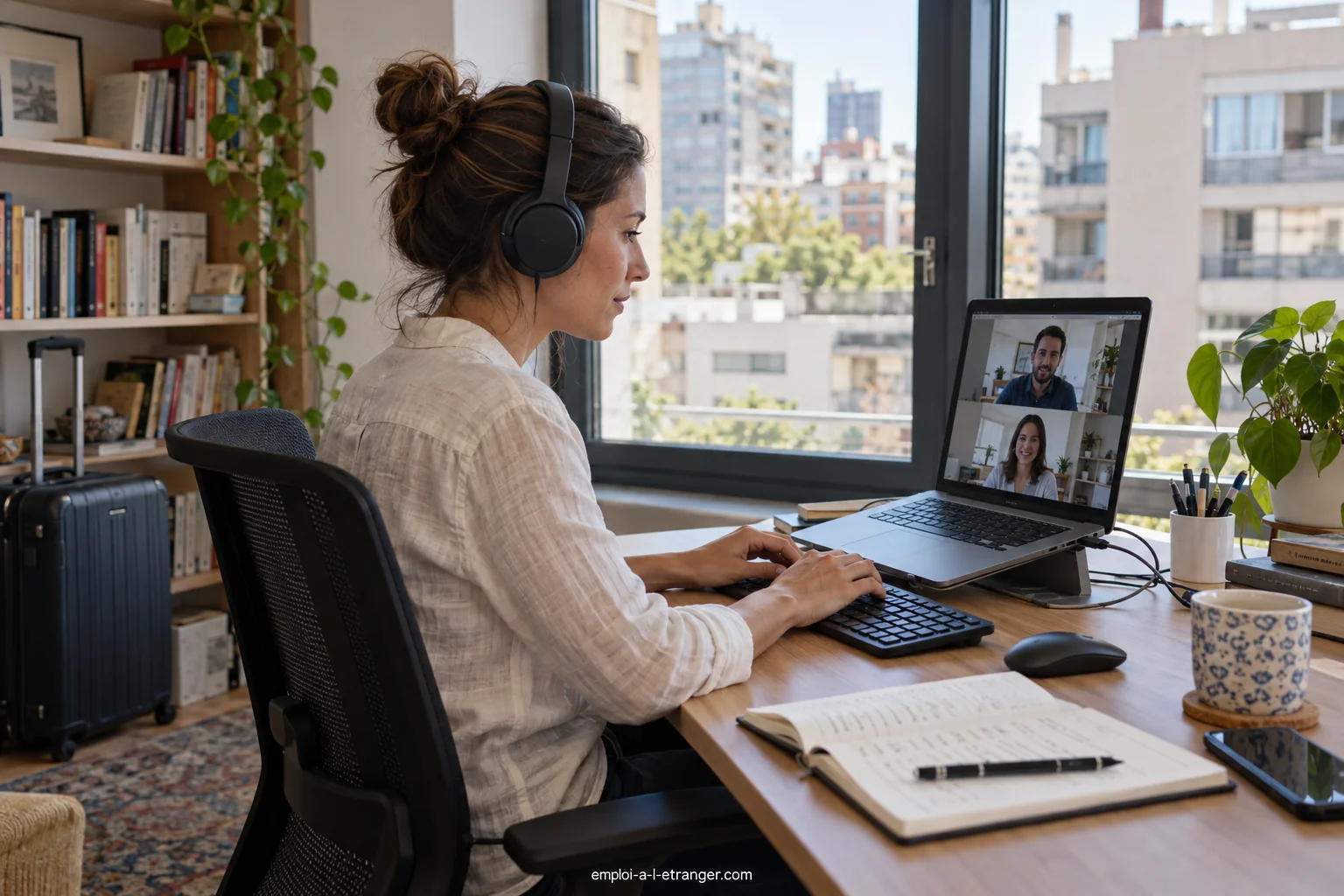
Working remotely abroad as an employee means keeping your job while living in another country. Here are the points to get validated before you book a flight. The first case: you are already an employee and want to work for a few weeks or months from another country. The second: you are looking for a job advertised as remote and will live abroad from the day you are hired. The legal, tax and social security questions are not the same, and the employer will not react in the same way in one situation as in the other.
Two situations not to mix up before you leave
In both cases, the right question is not “can I log in from somewhere else?” but “can my employer authorise me to work there, under what framework and for how long?”. Being technically able to connect is not the same as having permission. Put your request in writing, with the country, your planned departure and return dates and the reason, so that the company can consult its advisers.
What your employer has to examine on their side
A person working from another country can create local obligations for the company: declaring your presence, social contributions, the labour law of the place and even a risk linked to having a taxable presence there. Many employers therefore have an internal policy limiting the list of countries, the cumulative duration and the roles that are allowed. Ask for it before you put together a precise plan.
If no policy exists, do not conclude that anything goes. Propose a meeting with human resources or payroll, and ask for a written answer. A verbal agreement from your direct manager is not always enough: only the entity that employs you can commit to the payroll, contributions and cover that will apply during your stay.
- Exact country and place of work
- Departure and return dates
- Entity that pays your salary
- Role performed and expected working hours
- Written reply from human resources
Social security: where are you covered during the stay?
Health cover, work accident insurance and pension depend on the country of stay, the length of time and the agreements between states. In the European Union, coordination rules exist; with other countries, bilateral agreements sometimes apply, or nothing at all. Cleiss, the French centre for European and international social security liaison, publishes country-by-country information, and your own country’s social security body is the place to ask.
Do not rely on a loose answer such as “you stay covered”. Ask your insurance fund, the employer or the competent body which scheme applies, and on the basis of which document. Check the terms of your supplementary health policy and your travel insurance as well: many exclude work or limit the length of stay that is covered.
Tax and residence: questions to ask before departure
Working from another country can change where your salary is taxed, depending on the length of your presence, your personal ties and the tax treaty that applies. There is no simple rule valid everywhere. A presence of a few weeks does not have the same effects as a stay of several months; only an examination of your own situation allows a conclusion.
To limit the risk of error, count your days of presence in each country and keep the supporting evidence. Ask the tax authority or a competent adviser before you go, especially if your stay exceeds a few weeks or your family comes with you. Serious employers often ask for this documentation anyway before agreeing to a longer stay.
Time zones and core hours
Shared working hours are a classic source of friction. A difference of several hours can make team meetings a strain or force you to shift your day. Set out in writing the windows when you must be reachable, how often mandatory meetings take place and the response time expected for messages. This avoids complaints about expectations that were never stated.
Test the practical arrangement over a typical week: start and finish times, breaks, client calls, local public holidays and the company’s holidays. Plan a fallback for a power or internet outage, with an alternative place to work or a backup mobile data plan. Reliable remote work depends on a connection you have verified before leaving.
Equipment, data security and confidentiality
Some companies forbid taking equipment outside a given territory, or block access to their systems from certain countries. Check whether your work laptop may travel, whether VPN access will work from your destination and who handles repair or replacement if it breaks. Never bypass a technical restriction without the IT department’s say-so.
Confidentiality deserves as much attention as technology. Working in a shared space, a café or a hotel exposes client data. Ask for the company’s rules on privacy screens, public networks and calls. If your sector handles sensitive data, management may refuse certain destinations, which is nothing personal.
Reading a remote job advert: what hides behind it
Platforms such as We Work Remotely or Remotive publish remote vacancies from many employers. A lot of these adverts state restrictions: permitted countries, time zone, employee or contractor status. “Remote” does not mean “from anywhere”, and a role open to the whole world may in fact rest on a freelance contract.
Before applying, note what is said about the contract, the employing entity and social security cover. Ask the company whether it has a legal entity in your country of residence or goes through an employment provider. This detail changes everything: an employee has protections that a contractor invoicing for services does not.
Frequently asked questions
Can my employer refuse to let me work remotely from another country?
Yes, as a general rule. Working remotely abroad is not an automatic right, and the company can refuse for legal, tax, social security or data security reasons. A well-argued request, with dates, country and proposed arrangements, improves your chances. If approval is given, ask for it in writing with the precise conditions.
Do I stay covered by my home social security when working remotely abroad?
It depends on the country, the length of stay and the rules between states. In some cases you remain attached to your home scheme; in others, local affiliation is required. Ask your insurance fund and the employer, consult the information from bodies such as Cleiss, and obtain a document confirming the applicable scheme before you go.
Can I work remotely from a country without a work visa?
Do not assume so. Entry and residence rules vary, and a tourist stay does not always allow work, even remotely for a foreign employer. Some countries have specific schemes for remote work. Check the official information of the country concerned before booking or promising an arrival date.
Should I tell my health insurer and home insurer?
It is prudent. Policies often have limits on duration or country, and sometimes exclude professional activity. A home left empty for several months can also change your home insurance cover. Put the question to each insurer in writing, and keep their replies with your travel documents.