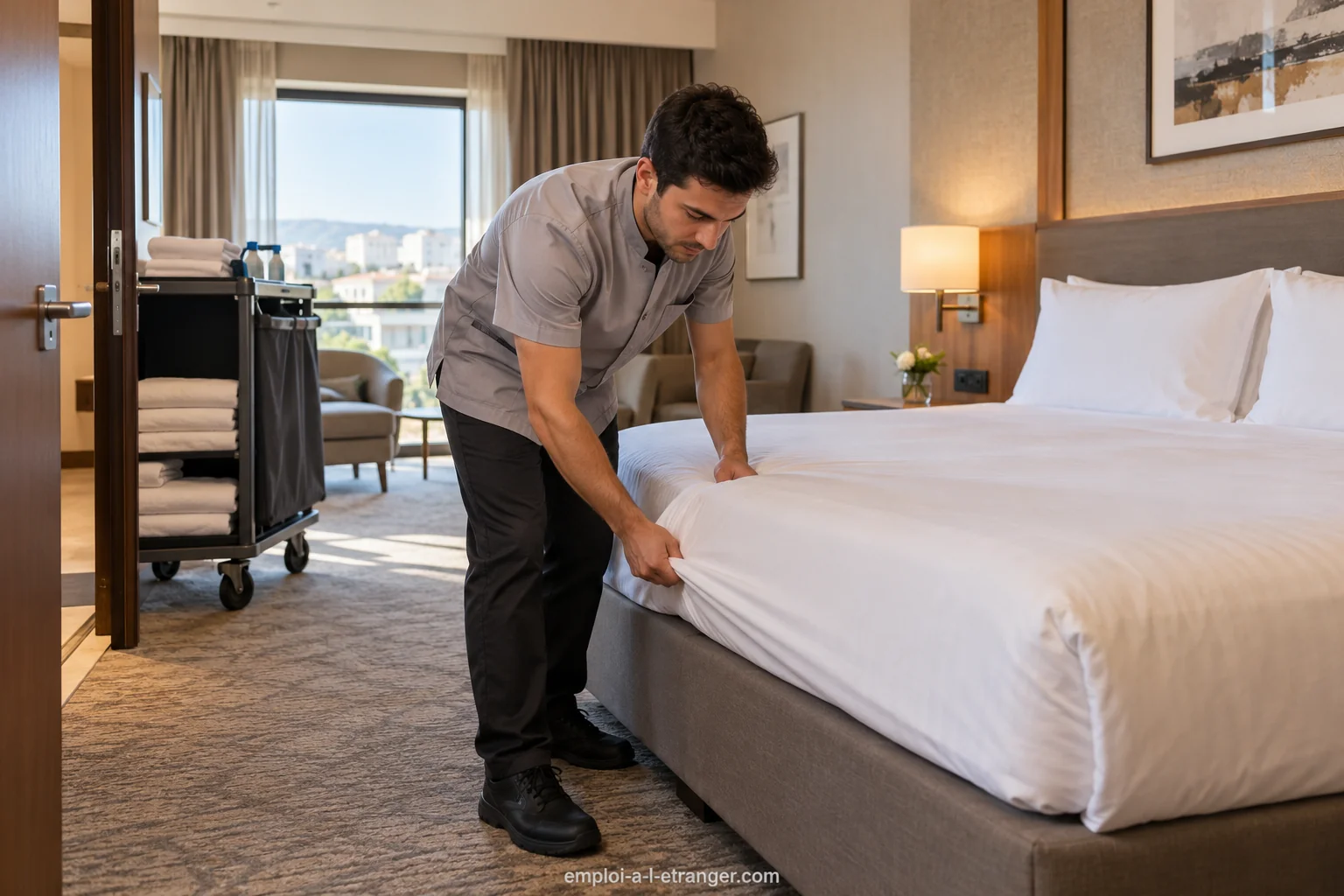
A Day as a Room Attendant: Rooms, Linen and Visual Checks
The day starts with the allocation of rooms. In each room you change the linen, clean the bathroom, vacuum, replace the welcome products, check the state of the furniture and report anything broken or missing. A final inspection, often by a housekeeping supervisor, signs the room off before it is sold.
Between tasks you manage the trolley, the linen stock, waste and lost property. The order of the rooms varies with departures, arrivals and special requests. The work calls for method, discretion and good physical stamina more than long training.
- Cleaning of check-out rooms and refreshing of stay-over rooms
- Linen handling and restocking the trolley
- Reporting faults and anomalies
- Handling lost property according to procedure
Room Quotas, Physical Load and Organisation by Building
The workload depends on the number of rooms assigned, their size and the distance between them. Ask how many rooms are planned per shift, whether the quota varies with the standard of the hotel, and whether a large room or a suite counts for more than a standard room.
Also ask about moving between buildings, the presence of lifts and handling equipment. Carrying mattresses, sheets or products for several hours a day strains the back and shoulders. An attentive employer trains staff in good posture and adjusts rotations where possible.
Equipment, Cleaning Products and Protection at Work
Cleaning products can irritate the skin or the airways. Ask which products are used, how they are labelled, whether gloves and goggles are supplied and whether training in their use is provided. The instructions must be understood in a language you master.
Check who supplies the uniform, the trolley, suitable shoes and lifting aids. An employee who must buy their own equipment or work without enough protection takes an avoidable risk. Raise these questions during the interview without fearing that you appear demanding, because they are normal parts of the job.
Direct Employer or Cleaning Contractor: Who Signs the Contract?
In many hotels, room cleaning is outsourced to an outside company. You then work in the hotel, but the service company employs you, sets your rota and pays your wages. The rules of this three-way relationship are not the same as for a member of the hotel’s own staff.
Identify the contractual employer and the person who manages the rota, overtime and payments. Ask how cover, public holidays and absences are handled. In the event of a problem you need to know whom to go to without chasing several contacts.
Tips, Bonuses and Pay: What to Understand From the Start
Pay can combine a fixed wage, attendance or productivity bonuses and tips. The weight of each element differs a lot depending on the country and the type of hotel. Do not count on a tip that the contract does not guarantee, and ask how it is shared out and declared.
Examine a sample payslip, the payment frequency, how night or weekend hours are paid and any deductions for housing, meals or uniform. Keep your own record of hours worked. If an employer refuses to show a written contract, be wary.
- Base wage and how often it is paid
- Treatment of overtime
- Sharing and declaration of tips
- Deductions for meals, housing or uniform
Housing, Transport and Breaks: Everyday Conditions
In tourist areas employers sometimes offer shared accommodation. Ask about the type of room, the number of occupants, the house rules, the distance to the hotel and the price if any. Compare with the local market, since housing provided can also tie your accommodation to your job.
Ask about start and finish times, how you get home after a late shift, breaks and meals. A clear organisation of rest periods limits fatigue. These points should appear in the contract or in written rules handed over when you start.
Moving Up in Housekeeping: From the Floor to Supervision
The job can lead to inspection duties, assistant housekeeper or team leader roles. Progress depends on the size of the hotel, in-house training and your command of the language. Ask for examples of people who have been promoted and the usual time it takes.
Experience in an upmarket hotel brings a rigour that is valued elsewhere. Keep employment certificates and, if possible, written appraisals from your supervisor. They will help you make the most of this first job in your career, especially if you later want to move into reception or management.
Applying for Housekeeper Jobs From Your Home Country
The CV fits on one page: cleaning or hotel experience, skills, languages spoken and availability. Avoid general phrases and name the types of property where you have worked. For a job abroad, state your level in the language of the country and your readiness to relocate.
Browse the jobs pages of groups such as Accor, Hilton or Relais & Châteaux, as well as offers from independent hotels. Above all check the work permit rules that apply to you and refuse any request for payment to obtain a job. Keep a budget to cover your first weeks.
Frequently asked questions
Do I need a qualification to be a hotel housekeeper abroad?
Generally not. Employers value reliability, speed, care and availability. Experience in hotels or cleaning is an advantage, as is enough of the local language to follow safety instructions. In-house training is often given when you arrive.
How many rooms does a room attendant have to clean per day?
It varies with the country, the standard of the hotel, the size of the rooms and the way work is organised. Do not rely on a general average. Ask for the expected number in your contract or at the interview, and find out how check-out rooms, stay-over rooms and suites are counted.
Can I be employed by a contractor rather than the hotel?
Yes, it is common in some hotels. You work in the hotel but your contract, rota and pay depend on a service company. Ask for the name of the legal employer, the person who manages the rota and the contact for questions on pay or conditions.
Is the housing provided by the hotel always free?
No. It may be free, charged or deducted from your wages, on varying terms. Ask for the exact cost, what is included, how long you can stay and what happens when the contract ends. Get these points in writing before you book your travel or give up your current home.