Describing your machines: the table that reassures a site manager
A foreign employer cannot guess what the phrase plant operator covers. Draw up a table: machine, make, approximate size, type of work, length of use. A tracked hydraulic excavator, a wheel loader, an articulated dump truck and a compactor do not call for the same movements or carry the same risks. Do not forget attachments: buckets, breakers, forks, grabs. Mastering them widens your profile and sometimes justifies higher pay.
State the terrain you have worked on: quarry, road, urban earthworks, dam, port. A sentence about the maximum slope, the proximity of buried utilities or working alongside pedestrians says a great deal about your skill.
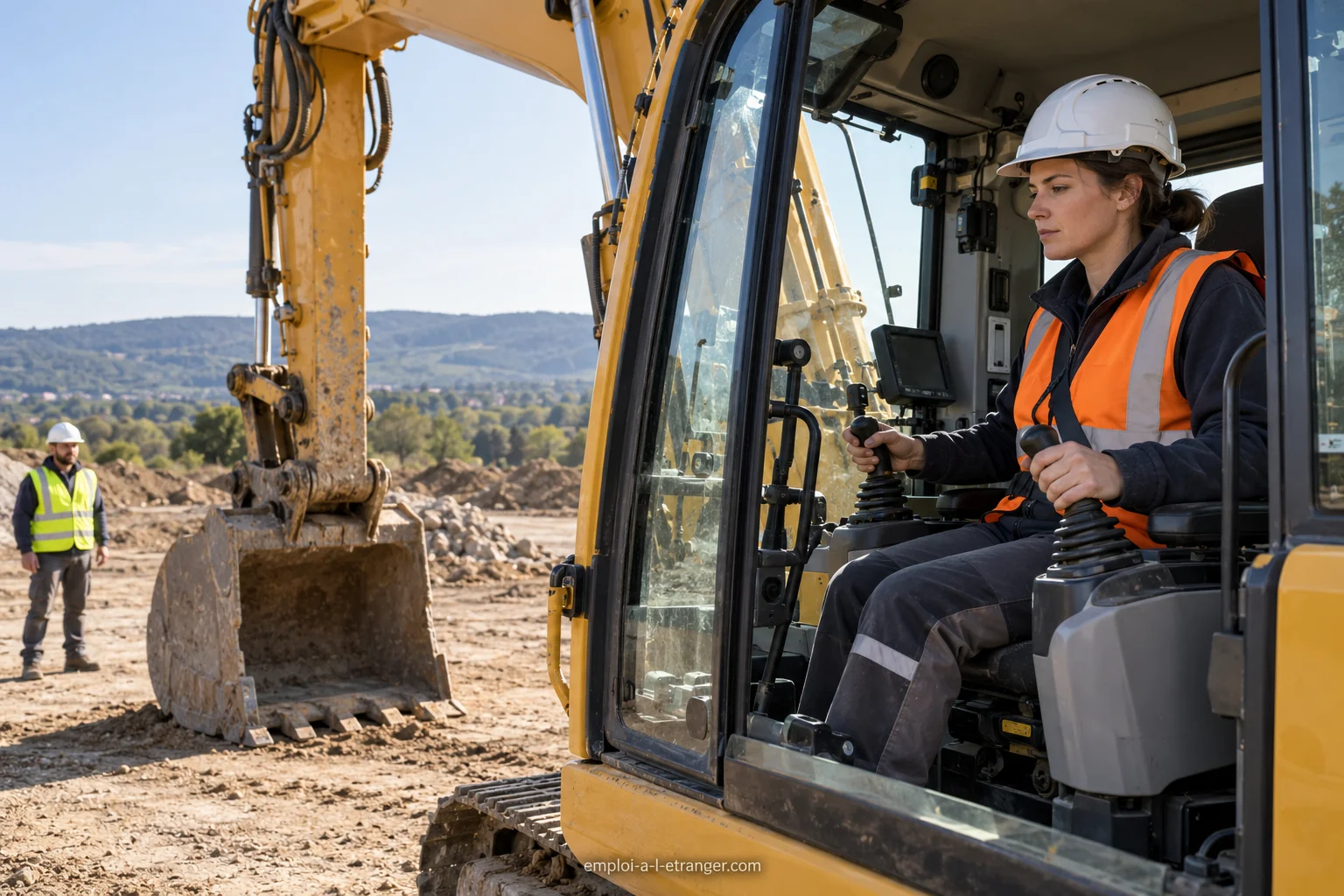
Keep a photograph of your previous machines too, as long as it reveals no confidential information; it illustrates your practice concretely and makes discussion easier in a video interview.
- Machine and approximate weight class
- Work done: excavation, loading, grading, lifting
- Environment: urban, quarry, road, port
- Length of use and period
Operating authorisations: why a national certificate is not always enough
An operating certificate obtained in your own country answers to its rules. Abroad, the site may require a practical test, a local certificate, a site safety card or an assessment by the company. Sometimes only an approved body in that country can issue the document expected.
Have the requirements confirmed in writing before you are assigned, along with who organises the assessments and who pays. Keep your certificates, their expiry dates, any translations and a record of operating hours from former employers close at hand.
Pre-use machine checks: a habit worth highlighting
Before every shift, a conscientious operator checks fluids, hoses, brakes, warning devices, lights, seat belts, mirrors and the condition of the bucket or forks. Explain how you do it and what you have already reported: a hydraulic leak, track wear, a faulty reversing camera.
International sites value people who know how to log a defect, take a machine out of service and wait for clearance to resume. Mention whether you filled in daily check sheets and in which language. Finally, say whether you can carry out minor first-level maintenance, such as greasing, checking levels or cleaning filters.
Communicating with ground crews: gestures, signals and radios
A machine operator rarely works alone. He coordinates his movements with labourers, banksmen, crane operators and truck drivers. If the language of the site differs from yours, standard hand signals, audible warnings and basic radio words become a safety issue.
Ask how the team communicates, whether banksmen are assigned to delicate manoeuvres and whether safety instructions are posted in several languages. Never play down a doubt about understanding: you have the right to stop the machine.
Maintenance, breakdowns and ground conditions: what the employer should explain
Ageing or poorly maintained machines are a major source of accidents. Ask who carries out maintenance, how often, how faults are reported and what happens when a machine stays out of action for several days. Your pay should remain covered during stoppages that are not your fault.
Ask about weather, dust, noise, vibration and heat as well. A site in an extreme climate calls for breaks, drinking water, air-conditioned cabs and suitable equipment.
- Maintenance schedule and named person in charge
- Procedure in case of a fault or breakdown
- Breaks, water, shelter, cab ventilation
- Site stoppage: pay and restart
Hours, travel and accommodation on remote sites
Many equipment jobs are far from towns: mines, roads, dams, energy parks. Ask about the distance between the accommodation and the site, the daily travel time, the vehicle used and how that time is counted.
Have the working pattern spelled out: continuous weeks, rotations, rest days, trips home. Check the quality of shared accommodation, catering, sanitary facilities and access to medical care. An assignment that looks lucrative on paper can become a burden if these points are neglected.
Finally, find out about the cost of living around the site. In isolated regions the price of food and communications can vary sharply, and distance complicates medical care. Ask whether medical assistance and medical repatriation are included in the contract, and how far the employer covers them.
Contract, insurance and residence permit for a foreign operator
The contract must name the employer, the site, the duration, the salary, the currency of payment and the insurance covering industrial accidents and health. Check that the company is registered and that your contact has the authority to sign. A recruiter who avoids these details should make you cautious.
To work legally you need the permit required by the host country. Ask the embassy or the competent administration, and never settle for a visitor visa. Do not pay money to an intermediary who promises a guaranteed job.
A short case study: moving from roadworks to a port project
An excavator operator used to roadside earthworks answers an advert for a port extension. He discovers that the excavator works on a barge, that the tides dictate the working hours and that radio communication is in a language he speaks only half well. His experience counts, but he must train for a new environment.
So he asks for a period of supervised support, rereads the safety instructions with an interpreter and refuses to operate alone before walking the site. Far from disqualifying him, this caution reassures the employer. Remember the lesson: you can be a seasoned operator and still admit without shame that unfamiliar ground calls for gradual adaptation.
Frequently asked questions
Is my CACES certificate recognised outside France?
This French certificate is accepted as proof of training by many employers, but its legal value depends on the country. Some sites require a practical test, a local card or an internal assessment. Ask what the company expects and confirm the rules with the relevant workplace safety authority.
Should you bring proof of your operating hours?
Yes, it is useful. Statements from former employers naming the machines used, the period and the types of work help a foreign recruiter assess your level. They do not replace a practical trial, but they make discussion easier and can speed up your assignment.
What are the risks if the machine is in poor condition?
You must report any defect before working and refuse to operate a dangerous machine. Ask the employer for the alert procedure and make sure no penalty applies to a justified stoppage. Keep a written record of your report, especially if the problem is not dealt with.
Can you start as a labourer and then become an operator?
It happens, especially when the company trains its own teams. Ask whether the labourer post is a genuine stepping stone, what training is planned and how soon an assessment is possible. Get these commitments in writing so that you do not stay long in a lower-paid role.