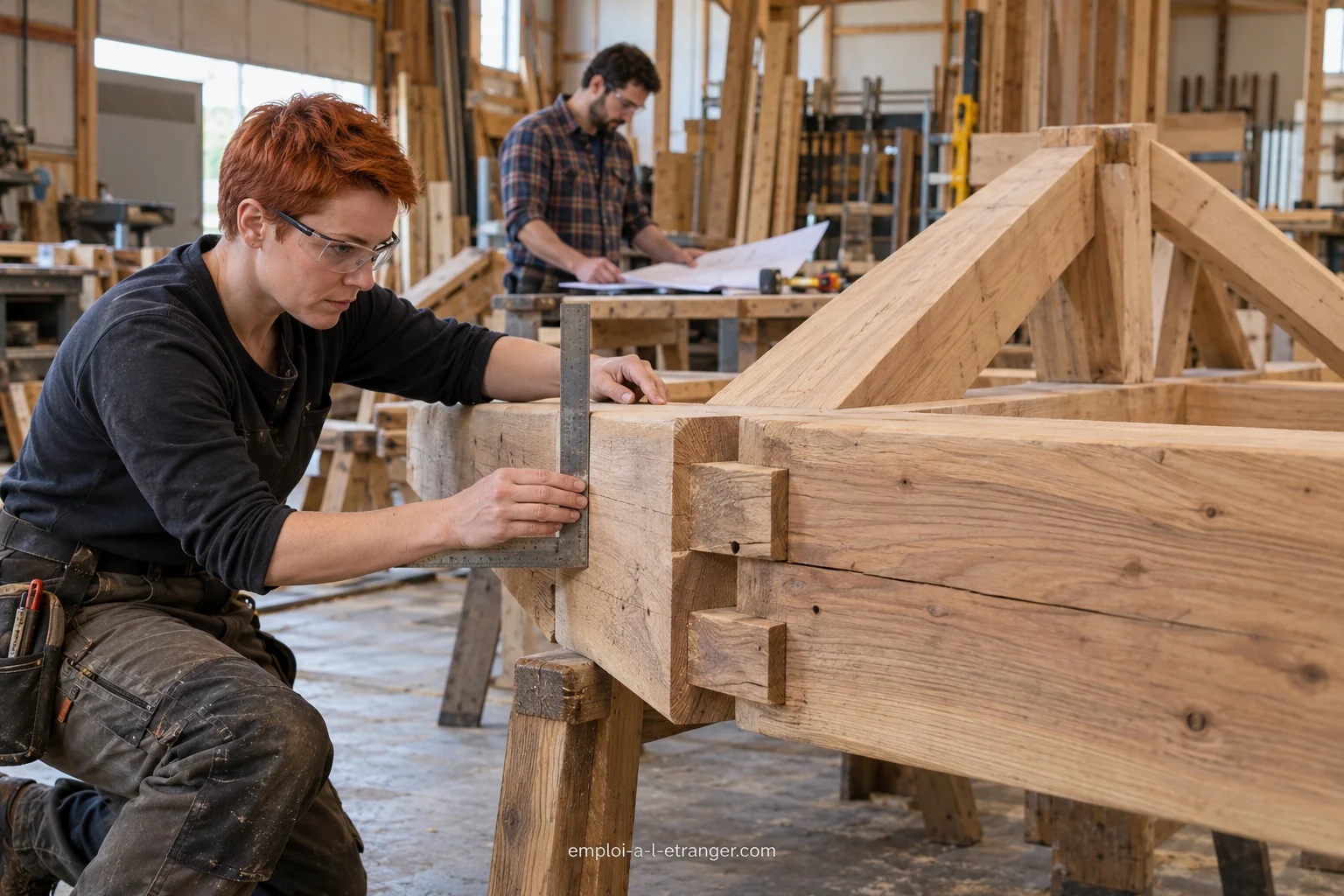
Workshop fabrication, site assembly or restoration: pick your profile
Structural carpentry includes preparation in the workshop, lifting and assembly on site, and the restoration of old structures. These three activities do not call for the same tools or carry the same risks. Say which one you do most and which one you would like to develop.
A recruiter abroad needs to see in a few lines whether you are mainly a layout carpenter, a cutter, a fitter, a team leader or a heritage specialist. A clear profile makes it easier to match you with a timber construction firm, a glulam workshop or a renovation site.
Think about your physical condition and your comfort with working at height too: some jobs mean long days outdoors, others take place mostly under cover. Choosing work suited to your experience limits the risk of accidents and early breaks in your contract.
Joints, materials and tools worth naming
Name the joints you have made: mortise and tenon, dovetail, halving joints, metal connections, mechanical fasteners. Specify the species and materials you have worked, such as solid timber, glulam, panels and framing. Add the workshop machines and portable tools you can use.
The more precise your list, the better a recruiter can judge your level. Do not, however, quote techniques you have only seen in training. A practical test or a workshop visit would expose the gap, and that damages your credibility for the rest of the assignment.
- Traditional and modern joints
- Timber species and materials handled
- Workshop machines you know
- Portable site tools
Past projects and your exact role: the trap of blurred responsibility
For every project you mention, state what you did yourself. Having made trusses in a workshop is not the same as having installed them at height under your own responsibility. A carpenter who erected a structure under a foreman should not present himself as the person in charge of the installation.
A simple table saves time: type of structure, approximate size, your role, length of the assignment. Attach photos you are allowed to use and, if possible, the name of someone who can confirm your part. This transparency reassures people about site safety.
Building systems, units and technical documents
Construction methods vary by country: timber frame, post and beam, prefabricated roof trusses, traditional roofs. Ask which system the company uses, which standards it applies and in which language the drawings and assembly instructions are written.
Units of measurement and drawing conventions may also differ. Plans in inches, locally standardised timber sections or an unfamiliar parts list slow down a newcomer. Ask for a sample drawing before you arrive, so you can get used to the symbols and abbreviations.
Climate and timber protection rules differ as well: humidity, snow, insects, permitted treatments. A structure designed for a dry climate is not erected in the same way in the rain. Put these questions to the company before you propose methods drawn from your own experience.
On site: handling, access and coordination with other trades
On a building site, the carpentry comes between the structural shell and the roofing. Your work depends on access to each area, the cranes or lifting platforms available and coordination with bricklayers, roofers and electricians. Ask how site meetings are organised and who gives the instructions.
Handling heavy pieces, working at height and the weather all shape daily life. Ask the employer about lifting equipment, collective protection, the safety gear supplied and how stoppages caused by wind or rain are dealt with.
Training, certificates and the induction before you start
Training required for work at height, operating lifting machinery or general site safety is not always recognised from one country to another. Ask the employer for the list of certificates needed, the ones it arranges and the ones you must bring.
A serious induction includes a tour of the site, the safety rules, the people to contact and the protective equipment. Check that the induction comes before any solo work. If the company asks you to work at height on day one without training, that is a red flag.
Paperwork, insurance and status: what must be in writing
An employment or service contract should state your status, pay, the site location, the length of the assignment and the cover in case of an accident. Find out about the insurance and social protection that apply in the country, and about who pays travel expenses.
If you work for a foreign company, make sure through the competent authority that your residence and your right to work are settled before the assignment. An employer who talks about simple formalities without putting anything in writing should lead you to ask for documented confirmation.
Lastly, ask how work accidents and sick leave are handled: whom to notify, what cover applies, what medical follow-up exists. These rules are rarely raised at interview, yet they matter a great deal in a physical trade.
Finding vacancies and judging how serious a company is
Vacancies appear on the careers pages of large construction groups, with manufacturers of building systems, on construction recruitment platforms and through direct contact with carpentry firms. Always compare the advert with the company’s official website.
A reliable employer names the site or workshop, the type of contract, the hours and the pay. Be wary of offers that ask for a payment to reserve a place or that promise immediate hiring with no technical interview and no check of your references.
Frequently asked questions
Is my carpentry qualification recognised abroad?
That depends on the country, on whether the trade is regulated and on the employer. Some posts are judged on experience and a trial, others require a recognised qualification. Ask the competent authority and keep your diplomas, work certificates and training records.
Do I need to speak the local language on a building site?
At the very least you must understand safety instructions and technical exchanges. Some international teams work in English, but site rules are often written in the local language. Ask how instructions are passed on and learn the basic vocabulary of the trade.
Can I go out as a self-employed carpenter?
It is possible in some cases, but the status depends on the country and on the relationship with the client. A false self-employed status can leave you without protection. Have the situation checked with the competent authority and get a written contract before you start.
What should go in a carpenter’s portfolio?
Gather a few representative projects with permitted photos, the type of structure, approximate size, materials and your precise role. Add a joint drawing if you made one. A short, honest file convinces more than a long album with no explanations.