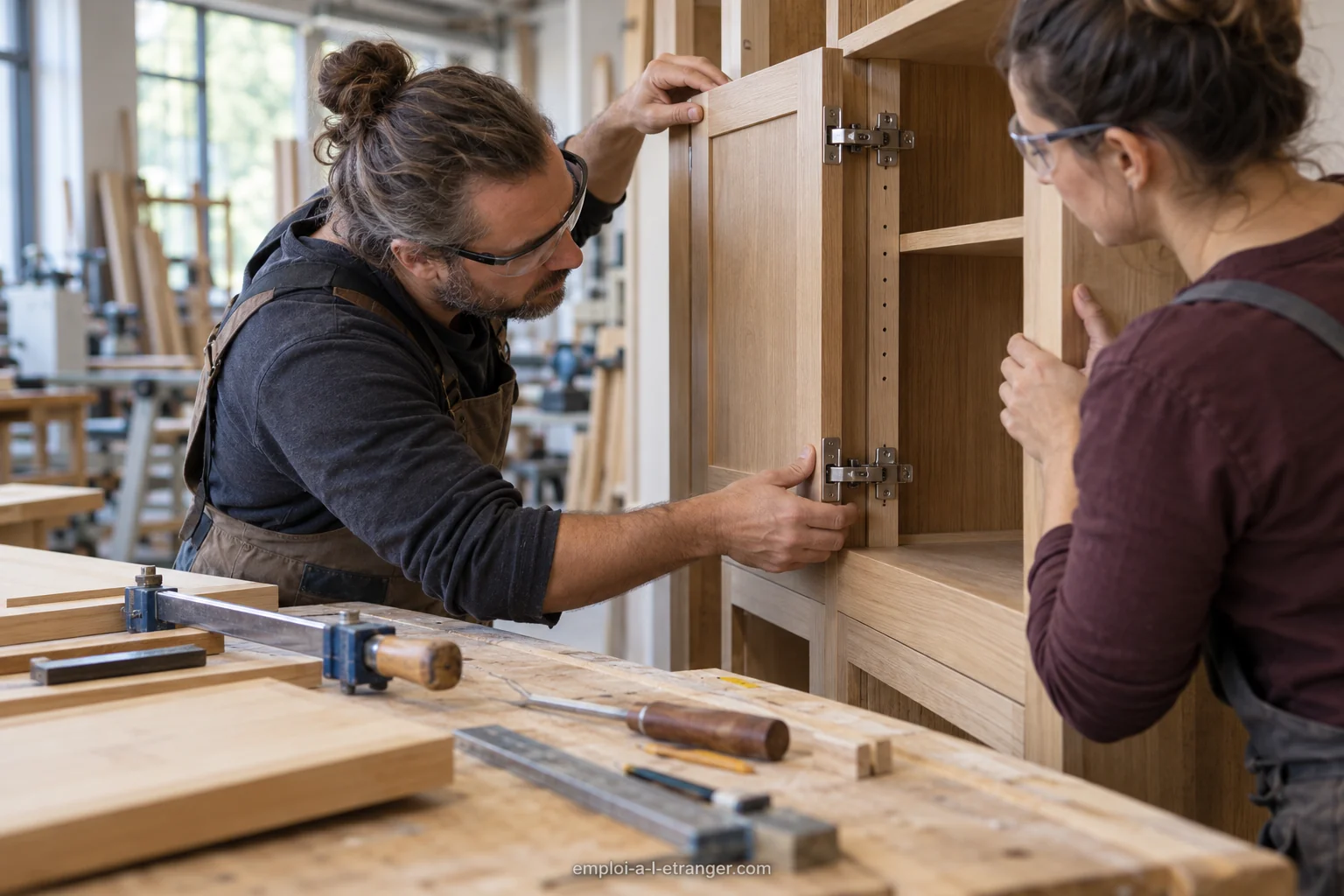
What a foreign employer expects from a joiner-fitter
An employer recruiting a joiner-fitter is rarely looking for a general woodworker. They want someone who can take measurements on site, turn a drawing into buildable parts, make them in the workshop and then install without damaging finishes already in place. Depending on the firm, the emphasis will fall on one or other of these stages.
A small shopfitting business will expect great versatility from you, from survey to installation. A larger company working for hotels or retail chains will divide tasks more: a design office, a manufacturing workshop and an installation crew. Read the ad looking for this split before deciding how to present yourself.
- Taking dimensions and checking surfaces
- Cutting, machining and assembly in the workshop
- Installation, adjustment and finishing on site
- Coordination with other trades
Putting together a portfolio that is easy to read
Choose three to six projects rather than a full catalogue. For each, give the type of venue, the materials used, the particular difficulty and what you did yourself. A curved counter in veneered panels, a bespoke bookcase fitted into an uneven wall or a glazed partition say more than a list of furniture.
Take photographs of the finished piece, but also of the workshop or the site while work is under way, because they show your method. If a project was done as a team, say which part you handled. A foreign recruiter who does not know you relies on these details to judge your level, far more than on a diploma title they cannot always place.
Machines, software and technical vocabulary
Fitting workshops increasingly run on CNC machines, edge banders and software for drawing and cutting lists. Specify what you have really used: programming, simply loading panels, tool setting or routine maintenance. The difference matters as much for safety as for the pay on offer.
Prepare the trade vocabulary in the working language too. The terms for a rail, a melamine panel, hanging hardware or a finish vary from country to country, and a misunderstanding over a drawing costs material. A short bilingual list, kept up to date as you exchange messages, avoids many manufacturing errors.
Workshop or site: asking the right questions
The job title does not always tell you how much of your time is spent at customers’ premises. Ask for the usual split over a month, how often you would travel, how far away the sites are and how travel is counted in the working day. A highly mobile post has a different daily life from a fixed workshop job.
Ask about tools too. Some employers supply everything, others expect the joiner to bring hand tools, or even a vehicle. Get it in writing what is provided, what is insured against theft or breakage, and who pays for fuel when you carry components.
- Share of time in the workshop and on site
- Tools supplied or to be brought
- Company vehicle or personal one
- Who is responsible for deliveries
Who approves changes and rework
On a fit-out job, the plan often changes at the last minute: a wall is not square, a piece of equipment is moved, a colour is altered. Ask who has the authority to accept such changes on site and how they are recorded. Without a clear framework, the joiner ends up bearing a deviation for which they are not responsible.
Have them describe how defects found after installation are dealt with. Who comes back, within what time, and is time spent on rework paid or absorbed in the project’s fixed price? A serious employer answers these questions simply. An evasive reply often signals an organisation where rework falls on the people in the field.
Qualifications, safety and the local framework
Requirements vary greatly from country to country: authorisation to work at height, protective equipment, training on finishing products, sometimes a professional site card. Do not assume that your home diploma or your years of experience exempt you from these formalities. Ask for the exact list before you leave.
To find out whether your trade is regulated in the target country, contact the body responsible for professional qualifications, the local labour ministry or the equivalent trades chamber. Deadlines and required documents change, and only an official source gives the up-to-date answer for your situation.
Finding employers and reading their ads
The leads are not limited to big names. Hotel fit-out firms, interior construction companies and high-end furniture workshops often recruit directly. The careers pages of building and interior-fitting groups let you see the profiles sought and the wording of ads before you send an application.
Read each ad separating what is required from what is preferred. A post asking for ten years of experience and the running of whole sites is not the same as a journeyman’s job in a workshop. Apply first to the ads where you meet most of the requirements, and tailor your file to each rather than sending one template.
Contract, housing and organising your departure
Before leaving your workshop, get a written proposal stating the place of work, hours, pay, probation period and type of contract. Compare these elements with the cost of living in the city concerned. A salary that looks attractive on paper can lose its appeal if housing swallows a large share of the income.
On the administrative side, separate the employer’s promise from the decision of the authorities responsible for residence and work permits. Taking your personal tools also raises questions of transport and customs. Ask the carrier and the authorities before shipping portable machines.
Frequently asked questions
Can a joiner-fitter be hired without speaking the country’s language?
It depends on the company and the job. In a workshop that works mainly from drawings, a bridge language such as English is sometimes enough at first. On site, with customers and other trades, the local language soon becomes essential for safety and to avoid misunderstandings. Ask for the real working language before deciding.
Do I have to bring my own tools abroad?
Not always. Some employers supply all the tools, others expect you to bring hand tools. Have it written down what is provided, what is insured and who pays for upkeep. For portable machines, also check the transport and customs rules before shipping, as they vary by country.
Is my home-country diploma recognised for this trade?
Recognition depends on the country and on whether the trade is regulated there. In many cases the employer judges mainly on experience and finished work. If a qualification is required, ask the country’s competent body or the diploma recognition information service, and request the list of documents to supply.
How can I tell whether the offer is genuine?
Check that the company exists, its address, that the job fits its business and who is writing to you. Be wary of an offer that asks for money before hiring or refuses to put conditions in writing. A reliable employer accepts questions about the contract, hours and workplace.