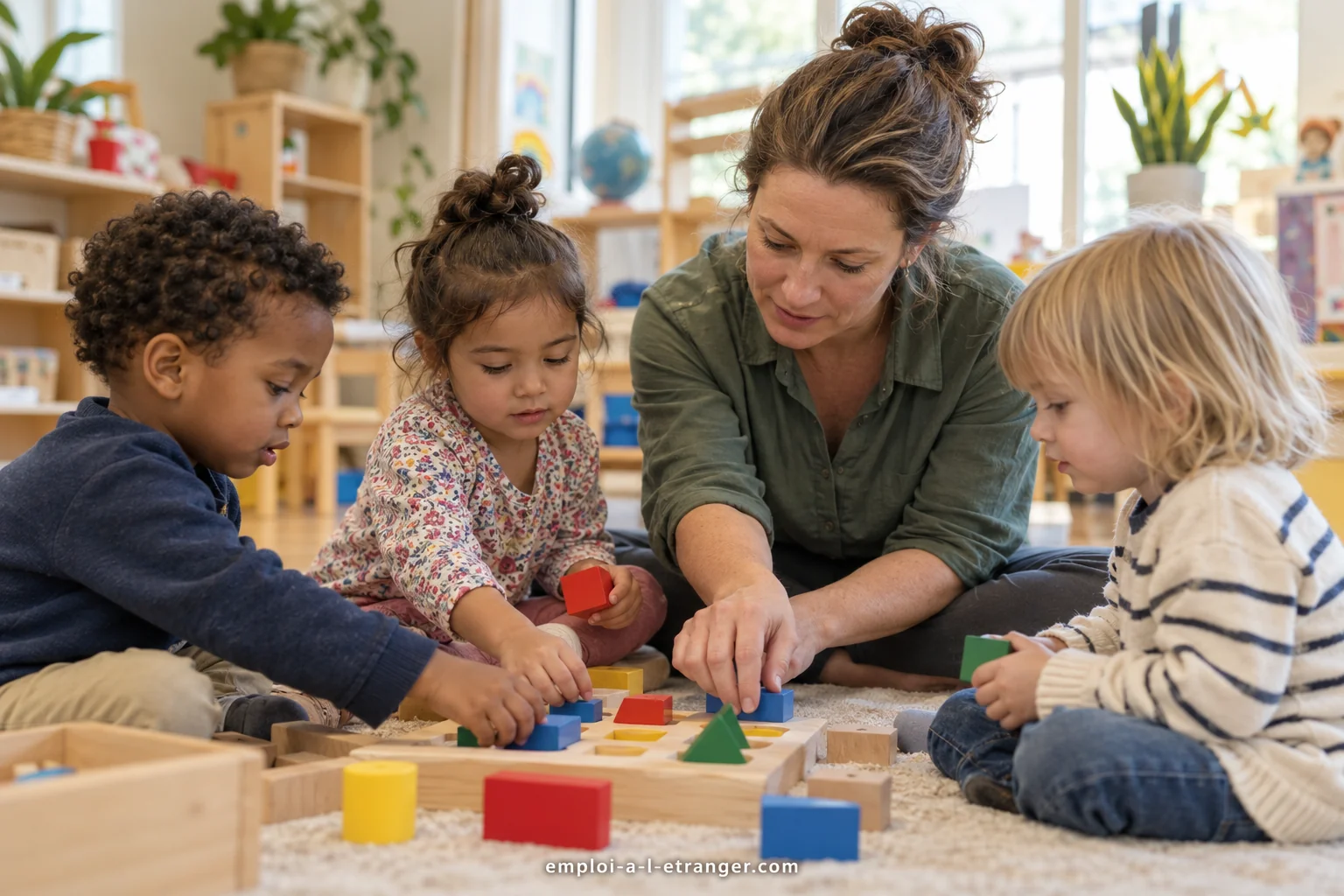
The Settings That Hire Staff for the Youngest Children Abroad
Employers are varied: private or public nurseries, workplace childcare networks, international kindergartens, bilingual pre-schools, charities and settings linked to expatriate communities. Each type has its own rhythm, its own teaching approach and its own qualification requirements.
First identify the age group you want: babies, children from one to three, or the class before compulsory schooling. Staffing ratios, activities and responsibilities are not the same. An application aimed precisely at one age group and one type of setting looks more serious than a general mailing to every nursery in a city.
Job Titles and Qualifications: Comparing Jobs That Do Not Share a Name
Depending on the country, the job may be called early years educator, nursery nurse, childcare assistant, kindergarten teacher or childcare professional. These titles do not always mean the same level of training or the same range of duties.
Before applying, compare your qualification with the one required locally. Ask the authority responsible for recognising qualifications and ask the employer. Depending on the country, an equivalence, extra training or an adaptation period may be requested. Keep your transcripts, course programmes and placement certificates translated.
- Local job title and level of training required
- Authority responsible for recognition
- Official translations of diplomas and transcripts
- Certificates of placements and experience in settings
Describing Your Practice With Young Children Without Exposing Families
The account of a real situation is worth more than a list of qualities. Describe how you observed a child who struggled to fall asleep, arranged a play corner to calm a conflict, or supported a morning separation. Show your analysis and the adjustments you made, not only your kindness.
Protect the identity of children and parents: no names, no photographs, no detail that would let a family be recognised. Describe how a day is organised, with meals, care routines and free play. A foreign employer will see whether your approach fits its own educational project.
Child Safeguarding and Pre-Employment Checks
In most countries working with children involves checks: a criminal record certificate or equivalent, a medical examination, professional references and sometimes first-aid training. The procedures, documents and timescales vary. Ask the employer for the list at the interview stage.
Find out about internal safeguarding procedures: how to report a concern, how accidents are handled, rules on physical contact, use of photographs. A serious setting presents them readily and trains you to apply them. A lack of procedures or oversight should worry you.
Keep certified copies of these documents and note their issue dates, since some employers refuse a document considered too old. If you have already worked with children in another country, ask for a matching conduct certificate. These steps can take several weeks, so start them as soon as your application is accepted.
The Everyday Language: Parents, Colleagues and Children
The working language goes beyond being able to speak to children. You must understand the team’s handovers, write short reports, talk to parents at drop-off and read health instructions. A functional level that is too low can limit your responsibilities in the setting.
In a bilingual kindergarten your French may be an asset, but the setting often also expects a good command of the local language or English. Ask in which language activities and meetings are held, and whether language training is planned during the first months.
Educational Approach and Team Organisation: Interview Questions
Each setting has a philosophy: Montessori, active learning, a welcome based on free play, or earlier and more school-like learning. Ask to read the educational project and see a typical day. Check that it matches your practice, because a gap in outlook causes daily friction.
Ask about organisation: group sizes, number of adults per room, preparation time, team meetings, supervision. Ask how cover for absences is managed and who decides in case of disagreement. The quality of support shapes your work as much as the salary on offer.
- Description of a typical day and its key moments
- Group sizes and adults present per room
- Paid preparation and meeting time
- How cover is arranged during absences
Au Pair, Nursery or Home Childcare: Do Not Confuse the Statuses
Some adverts mix several realities: care in a group setting, work in a family home, a cultural exchange programme. Rights, hours and social protection are not comparable. Ask who your employer is, which contract you will sign and which authority oversees the activity.
For work in private homes, check the legal framework, how the work is declared, insurance and weekly hours. For a group setting, check the registration or operating licence. An offer that skips these points or refuses a written contract does not deserve your trust.
Preparing to Leave: A Timetable of Steps for an Educator
Begin with recognition of your qualification, since it is often the longest step. At the same time put together a CV centred on age groups and practice, then a letter explaining why you chose the country. Target a few settings whose project interests you, for example networks such as Bright Horizons, Busy Bees or Fröbel.
Once you have an offer, check the work permit, the contract, housing and health cover. Allow an adaptation period, because the way children are cared for varies from one country to another. Keep savings to absorb an administrative delay rather than leaving without a margin.
Frequently asked questions
Is my early years educator qualification valid abroad?
Its value depends on the country and the setting. Some accept the diploma with a translation, others ask for an equivalence or extra training. Contact the authority responsible for recognising qualifications and the employer before applying, and keep your transcripts and placement certificates.
Do I need the local language to work in a nursery abroad?
Almost always, at a level that lets you follow handovers, talk to parents and apply safety instructions. A bilingual setting may accept a more modest level if French is sought, but it generally expects a common language with the team. Also ask whether a language course is funded.
What documents are required to work with children?
Practices vary, but employers often ask for a criminal record certificate or equivalent, medical proof, references and training certificates. Ask the employer and the competent authority of the country, since these documents can take a long time to obtain. Keep certified copies of each one.
Can I work as a home childcarer without a written contract?
It is not advisable. A written contract sets out hours, pay, days off and responsibilities. Without it you are poorly protected in a dispute, an accident or a termination. Also check the rules on declaring the work and on insurance in the country concerned.