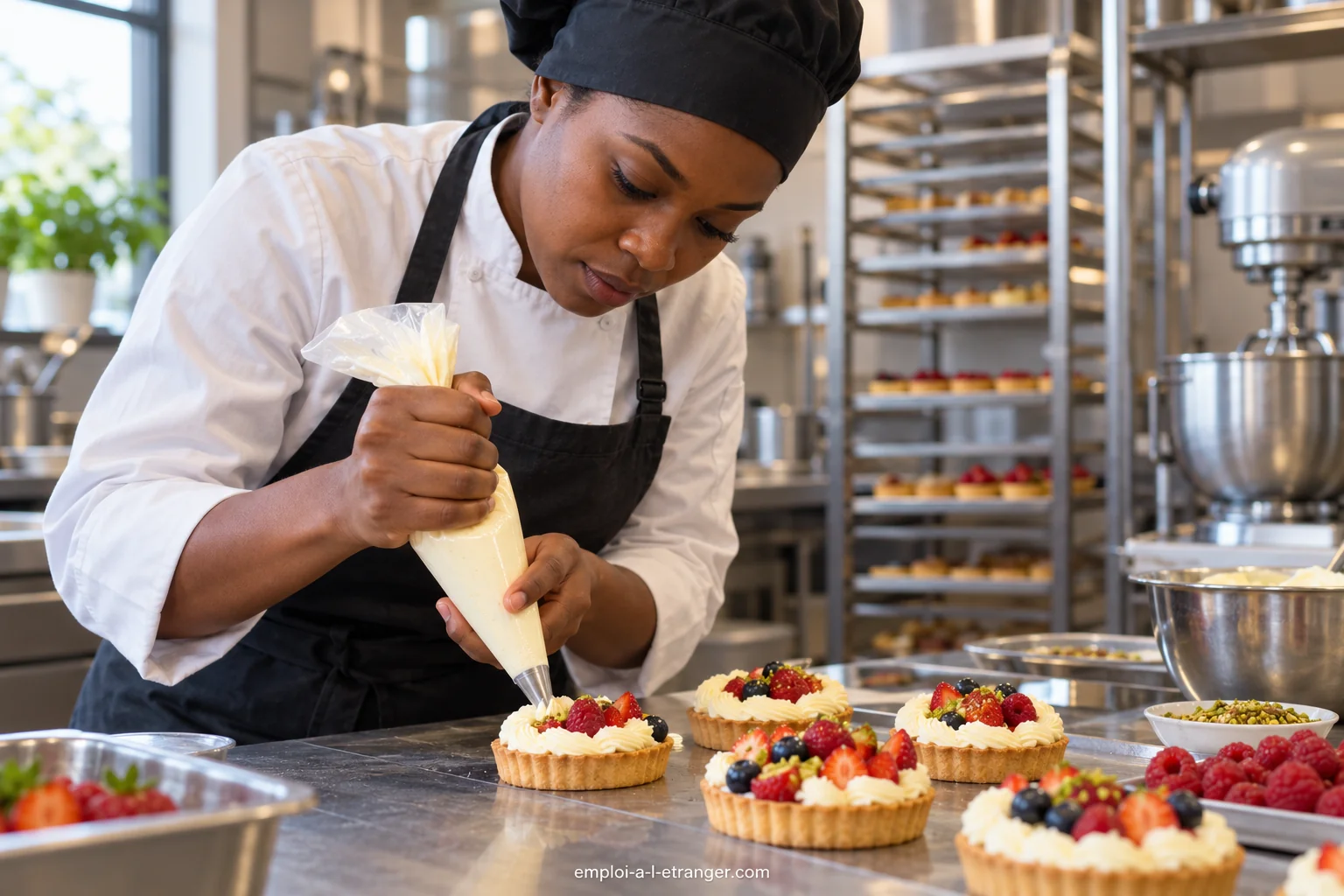
Hotel, restaurant, shop or workshop: where your skills fit
A hotel pastry chef produces for breakfast service, banquets and sometimes a fine-dining restaurant, with large volumes and unsocial hours. In a restaurant, plated desserts demand dexterity and creativity in a small space. In a shop, consistency and window presentation come first, while a production workshop favours speed and repeatability.
Work out which type of business matches your experience and taste. Your applications will be more coherent if you highlight, for each target, the work closest to it: batch entremets, desserts made to order, laminated viennoiserie, showpieces or chocolates.
A pastry portfolio: few pieces, plenty of context
Select five to eight pieces and photograph them under good conditions: soft light, a neutral background and a cross-section visible for a layered cake. Add a short text to each: composition, technique, quantity produced, shelf-life constraints and your exact role in making it.
A photograph alone does not say whether the piece was made ten times or two hundred. The recruiter wants to gauge your independence and consistency. If possible, add a short video of a technical gesture, such as laminating dough or glazing, filmed plainly and without intrusive music.
- Layered cakes with a cross-section and a description of textures
- Viennoiserie: lamination, baking, consistency
- Plated desserts and presentation
- Volume production: quantities and organisation
- A personal piece that expresses your style
Getting ready for the trial: instructions, ingredients and time management
Many kitchens ask for a trial lasting a day or half a day. Find out beforehand what is expected: a set recipe, a free creation, help with production. Ask which ingredients are available, because butter, flour, chocolate and sugar do not behave the same way everywhere.
Arrive with your uniform, your small tools and a notebook. During the trial, set up your station, read the whole recipe before starting, and taste, then taste again. Chefs watch your cleanliness and calm as much as the result. Ask for feedback at the end, even if it is critical.
Use the day to observe the kitchen too: the mood among colleagues, how people speak to each other at the busiest moment, the state of the equipment, the cleanliness of the cold rooms and respect for breaks. A trial works both ways, and what you see in a few hours says a lot about what your working weeks would be like.
Production hours, rest and workload at festive times
Work often starts very early or very late, depending on whether the kitchen prepares the morning bread or the evening desserts. Ask about the hours on site, the length of split shifts, how often weekends are worked and how cover is organised.
Festive seasons, weddings and tourist peaks bring surges of activity. Some businesses compensate with time off or bonuses, others do not. Ask exactly how overtime is counted and paid. A well-organised kitchen plans these periods several weeks ahead.
Hygiene, allergens and permits that depend on the country
Food safety rules cover the handling of ingredients, the cold chain, allergen labelling and traceability. They differ from one country to another and are checked by local services. Ask the employer which training is required and which it provides, for example in food hygiene.
Do not assume that your home qualification is enough everywhere. Some countries ask for a specific certificate, a medical check or a trade card. Ask the authority responsible for food safety and keep a copy of the certificates you obtain, because they will be requested during inspections.
Local ingredients: adapting without losing your signature
Butter, flour, chocolate, sugar and fruit vary by region, and so do customers’ tastes. A lightly sweetened French-style entremets may surprise in a country where desserts are richer. Look at the products on sale, taste those of competitors and adjust your recipes methodically.
Suggest to the chef one or two ideas that combine your technique with a local product, without upsetting the menu. This shows your openness and your ability to create within a given framework. It also lets you pass on know-how without appearing to impose a single way of doing things.
Pay, meals, housing and status
Compare offers carefully: base salary, supplements for night or weekend work, meals provided, uniform, laundry and transport after a late shift. If housing is included, ask where it is and what it really costs. Some establishments deduct these benefits from the wage, others do not.
Check the status offered: employee, trainee, apprentice or seasonal worker. An unpaid traineeship is not the same as a job, even when the tasks are identical. Have the duration, the duties and any right to an extension put in writing, and leave only with a contract that complies with the law of the host country.
Career progression: section chef, head of pastry, starting a business
A first post abroad often acts as a stepping stone. With experience you can aim for section chef, sous chef pastry or head of the pastry kitchen. Ask whether the business trains its teams, promotes from within and whether you would get a say in ordering or planning.
Some pastry chefs eventually open their own shop in the country. This step needs a licence to trade, capital, knowledge of the market and a residence status that allows it. Ask the local administrations early rather than committing money on a mere assumption.
Frequently asked questions
Is a French pastry diploma recognised abroad?
Employers generally value it, but official recognition depends on the country and the type of post. In practice, the kitchen trial and your experience often count for more. For a regulated activity, such as opening a shop, ask the local authorities.
Is the trial shift in the kitchen paid?
It varies by country and by employer. A short, supervised trial is common; a long unpaid period calls for caution. Ask about the length, the planned tasks and the legal framework before you travel, and refuse to make items meant for sale without payment.
Do I need to speak the local language to work in pastry?
Basic technical vocabulary is often enough to start: ingredients, quantities, temperatures, hygiene instructions. In an international kitchen, English may serve as the common language. Still, learn the safety and labelling terms used in the country to avoid mistakes.
Where can I find pastry chef jobs in international hospitality?
Hotel groups publish their vacancies on their careers pages, such as Accor Careers or Relais & Châteaux Careers, and the Hosco platform gathers adverts from the sector. Check the establishment, read the contract carefully and never pay to be recruited.