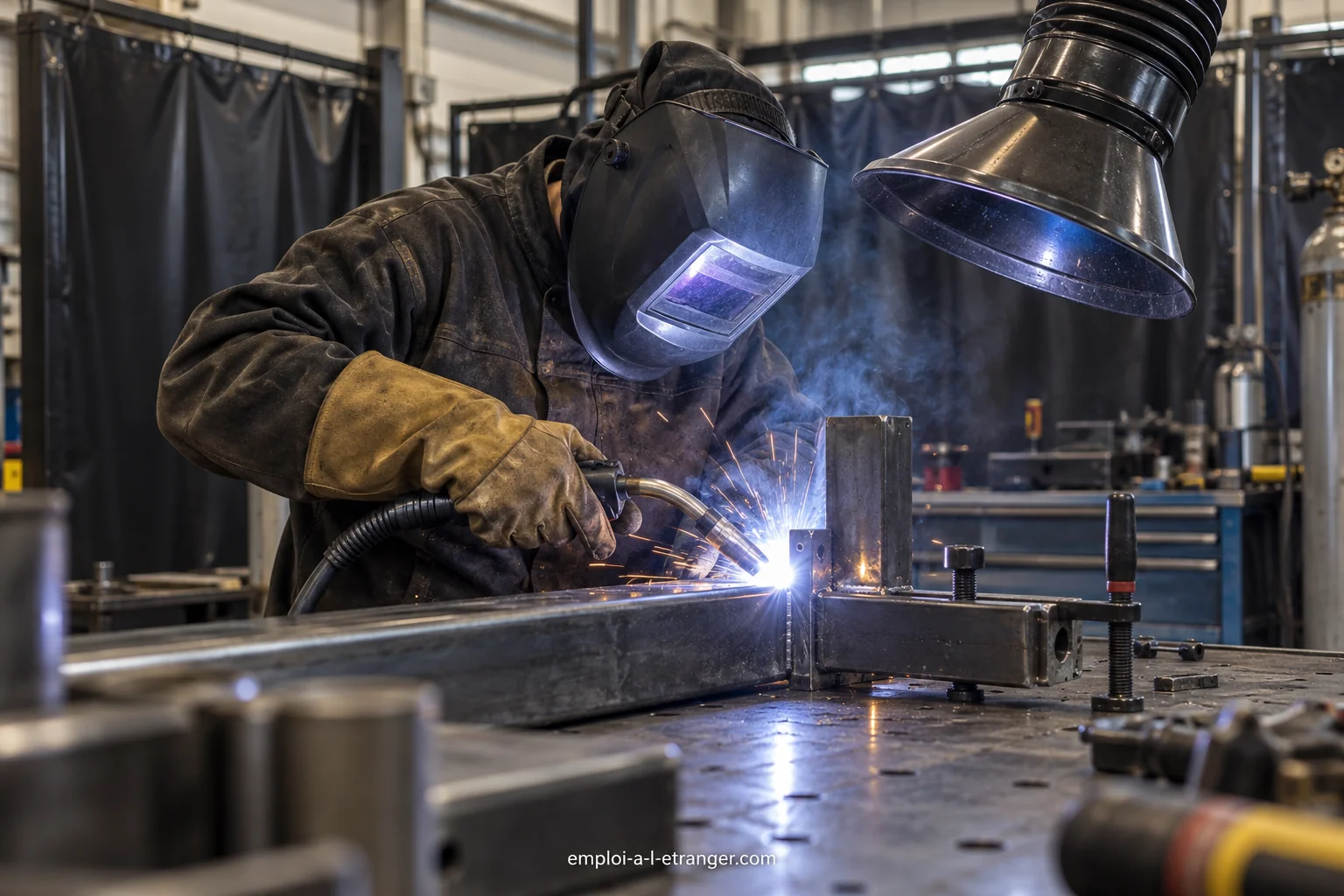
What a Recruiter Reads First in a Welder’s CV
The recruiter first wants to know whether your practice matches the job. So they look for the process (TIG, MIG/MAG, stick electrode, flux-cored wire, submerged arc), the material (carbon steel, stainless steel, aluminium, special alloys), the usual thickness and the positions you have mastered. One line per type of work is better than a general phrase.
Then add the kind of structure you built: light fabrication, structural steelwork, process piping, tanks, offshore structures, rail or bodywork. Say whether you welded from drawings or from sketches, and whether you inspected your own beads. These details let a workshop manager place your level in a few seconds.
- Processes you use and years of practice for each
- Materials and thickness ranges you have worked with
- Welding positions used in production
- Typical work: pipework, steelwork, tanks
- Inspections carried out: visual, dye penetrant, magnetic particle
Welder Qualifications: What Your Certificate Is Worth Abroad
Welder qualification certificates are issued under standards and codes that vary from one country or sector to another. A certificate obtained in France may be accepted as it is, may need a supplement, or may have to be redone locally. The answer depends on the code for the work and on the end client, not only on the country.
Keep the originals, the validity dates and the proof that your qualification has been maintained, because an expired certificate is worth nothing. Ask the employer which standard they require and who organises the qualification test. Depending on the case, it is the company, a third-party body or the client that runs it.
Fixed Workshop, Site Pipework or Construction Site: Three Different Jobs
In a workshop the work is divided into stations, with overhead cranes, jigs and built-in quality control. The pace is steadier, the risks are better controlled and housing often remains your personal choice. Versatility is appreciated, but the production rate is high.
On a construction site or a plant shutdown you weld outdoors or in confined spaces, often within a subcontracting team. Hours adapt to the constraints of the site, travel is frequent and inspections multiply. Ask clearly in which setting you will be assigned, because the same job title covers very different conditions.
The Practical Test and the Technical Interview: What to Expect
Many employers ask for a test on a sample piece before confirming the hire. The test may take place in the recruiter’s workshop, at an approved centre or, sometimes, in your home country. Ask about the material, the position, the procedure provided and how the result will be communicated.
The technical interview often covers reading a drawing, a weld symbol, a distortion to correct or a defect to identify. Prepare concrete examples of difficult parts and explain how you solved the problem. A clear description of the mistakes you avoided reassures more than a story with no rough edges.
Welder Safety and Health: Questions to Ask Before You Accept
Welding exposes you to metal fumes, radiation, burns, noise and awkward postures. Protection practices vary between companies and countries. Ask whether extraction at source is installed, who supplies the mask, gloves and clothing, and how the medical check-up is organised.
On a construction site, find out which certifications are required, what induction training is given, and what the rules are on hot-work permits and confined spaces. A serious employer answers these questions directly. A vague reply or a downplaying of the risks should make you ask for written details before any commitment.
- Fume extraction and ventilation at the work station
- Protective equipment supplied or to be bought
- Medical follow-up and induction training
- Hot-work permits and confined-space rules
Rotations, Accommodation and Allowances: Reading the Clauses
A remote assignment sometimes comes with a rotation system, with periods of work followed by rest. Get in writing the pattern, the departure point of the journey, who pays for the tickets and what happens if the project overruns. These elements weigh as much as the hourly rate in your decision.
If the employer houses the crews, ask about the type of accommodation, the distance to the site, catering and the rules of the camp. Then compare the real cost of your stay with what is covered. Some allowances compensate for remoteness, while others only cover expenses, which changes the financial picture.
Spotting a Welder Job Offer That Is Too Good to Be True
Welding job offers are widely circulated, and some are bait. Be wary of hiring without an interview, an employer you cannot trace, a payment requested for the file or the visa, or pay far above the market. Check that the company exists, its address, its project references and the name of someone you can reach.
For a regulated job or one that needs a work permit, ask the immigration authority and the public employment service of the country concerned. A legitimate employer can explain who files the application and roughly how long it takes. Refuse any arrangement that would have you working without a clear legal framework.
Timeline of a Welder’s Application, From File to First Job
Start by gathering your certificates, your references and photos of parts you have made, while respecting client confidentiality. Write a one-page CV centred on processes and structures, then a translated version if the employer asks for one. Target a few companies rather than sending applications blindly.
After the interview and any test, compare the written offer with what was said. Then check the work permit, health insurance, housing and arrival date before you leave your current job. Large construction and engineering groups, such as Bechtel, Fives or VINCI, publish vacancies on their careers pages.
Frequently asked questions
Is my French welding qualification recognised abroad?
It depends on the country, the sector and above all the fabrication code imposed by the client. Some employers accept your qualification, others require a new test on site. Ask which standard is used and which body issues the certificate, then keep the validity dates of your documents.
Do I have to take a welding test before being hired?
It is common, especially for pipework, fabrication or code-governed work. The test is done on a sample piece with a defined process, material and position. Ask for the details in advance, and find out who pays for the cost and for your travel if you have to go elsewhere.
Which welding process is most in demand abroad?
None dominates everywhere, because demand follows the sector. TIG on stainless steel interests food processing and chemicals, MAG suits steelwork and construction, and stick electrode is used on outdoor sites. Study the adverts in your target sector and highlight the process you really practise.
How can I tell whether a welder job offer is genuine?
Check that the company exists, its address, the person contacting you and its project references. A serious offer includes an interview, a written contract and no payment request. Also contact the public employment service of the country concerned to confirm the work permit rules.