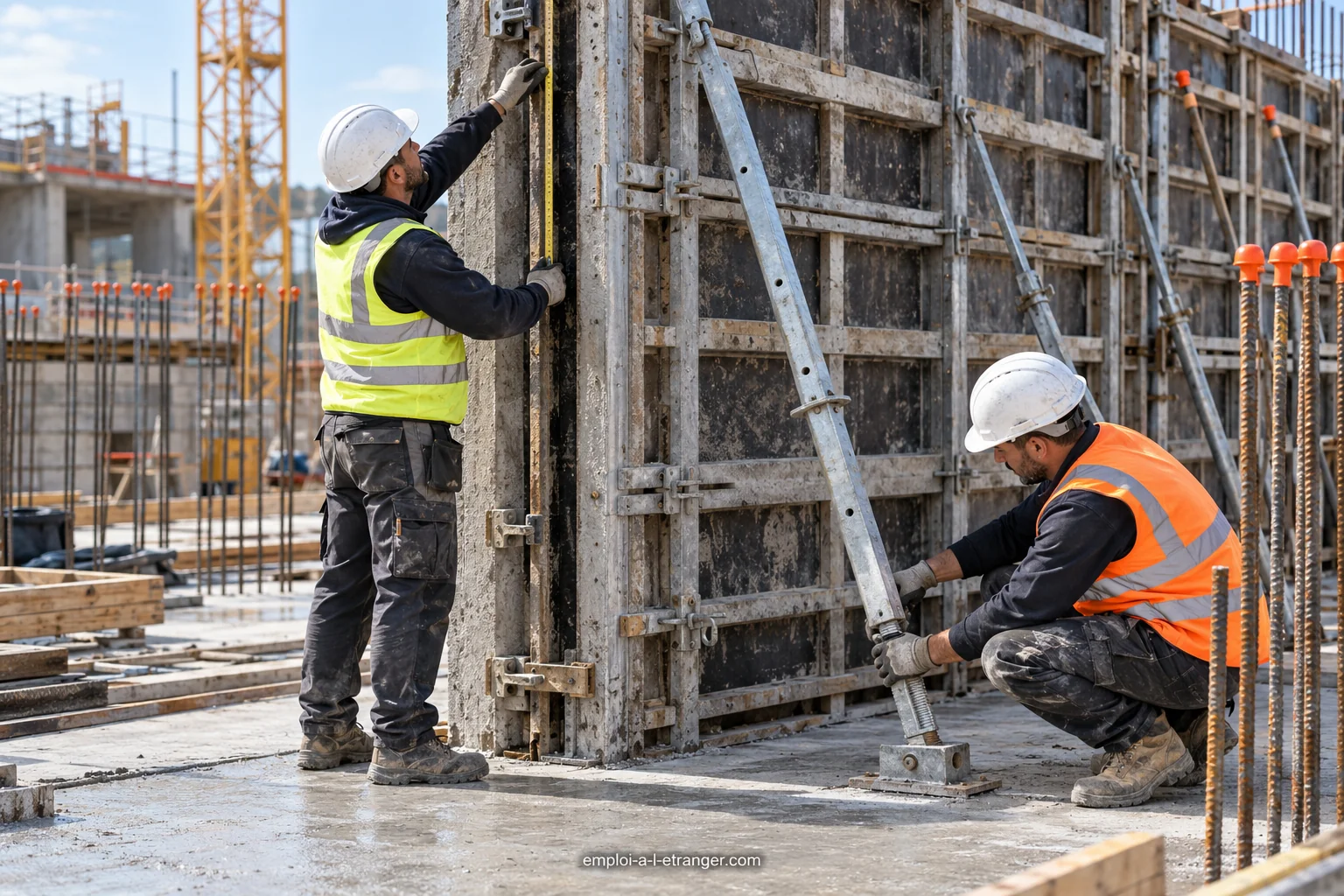
What a foreign site looks for in a formwork carpenter
A foreign site manager or project manager wants first of all a worker who can erect formwork to the drawing, in the right order, without rework. They judge this reliability from your references: types of structure, heights, work rates, team sizes. A carpenter who has built lift-shaft walls does not have the same experience as one who has built housing slabs.
Building and civil engineering firms also hire for specific periods, following the phases of structural work. Your availability therefore counts as much as your technique.
Inventory of your techniques: panels, traditional, modular systems
List what you have really handled. Hand-set panels or large crane-lifted panels, traditional timber formwork, table forms, climbing systems, permanent formwork: each family involves its own movements, adjustments and safety instructions. Name the equipment brands you know if you master them.
For each site, indicate the type of structure, how long you worked there and your role: operative, team leader, setter-out. One clear sentence about a site is worth more than a long vague list. If possible, attach site photographs in which faces and company signs cannot be identified, along with the name of a former site manager willing to confirm your dates. These items reassure an employer who cannot visit your previous sites.
- Types of formwork used and equipment brands
- Structures built: housing, bridges, car parks, civil works
- Role held: formwork carpenter, team leader, setter-out
- Length and period of each assignment
Reading drawings and pour sequences: examples to cite
Formwork drawings follow conventions that differ from country to country: units, symbols, revision codes, the language of legends. If you have already worked from drawings by foreign architects or design offices, say so.
Describe a situation where you had to respect a sequence: striking after a curing time, a construction joint, positioning openings for services. The recruiter sees in it your rigour and your ability to coordinate your work with steel fixers, crane operators and masons.
Safety at height: certifications and equipment to clarify
Formwork work exposes you to falls, suspended loads and heavy lifting. Requirements vary: scaffolding certificates, working-at-height training, wearing a harness, a site safety card. A certification obtained in France is not automatically recognised elsewhere.
Ask the employer which training it requires before you arrive, which it arranges itself and who bears the cost. Find out also about the protective equipment supplied, the person in charge of safety and the procedure in case of an accident. Note the language of the safety notices posted on site too: a sign you cannot read is a real risk, and an interpreter or a bilingual team leader should then be appointed.
Days worked, travel and waiting: reading a schedule without illusions
An assignment advertised for several months may include days with no actual work: bad weather, waiting for a concrete delivery, another crew running late. Ask how these days are paid, whether daily travel is paid and whether travel time between lodging and site is counted.
Have the weekly hours, the length of breaks, the rest days and the overtime arrangements spelled out. Pay that looks attractive can turn out average if it covers very long weeks. Keep your own record of the hours you really work each day; it will help if there is a disagreement over payment.
Direct employer, subcontractor or agency: who really hires you?
On large projects the chain is often long: client, main contractor, subcontractor, sometimes a placement agency. The entity that signs your contract determines your rights, the applicable law and who must pay you.
Insist on the full name of the employer, its address and the exact site location. Check that the company is registered and that it takes on housing, insurance and repatriation if the contract provides for them. If the contact stays vague on these points, do not send your personal documents.
- Legal name of the employer and the main contractor
- Exact site location and length of contract
- Housing and transport provided
- Health and workplace accident insurance
Work permits and recognition of qualifications
Outside the European area, a formwork carpenter is almost always hired subject to a permit or a visa tied to the job. The procedure may require proof of qualification, a signed contract and medical examinations. It does not always begin before signing, and its outcome is never guaranteed.
Consult the country’s embassy or consulate, as well as the competent labour or immigration authority. Never leave on a simple tourist visa: working without authorisation exposes you to penalties and leaves you with no protection at all.
A typical case: preparing a first six-month assignment
Imagine a thirty-year-old formwork carpenter, used to walls and slabs in apartment blocks, who answers an advert for a tower project abroad. He starts by sorting his references and checking his safety certificates, then asks the company for a video call with the site manager. He asks four questions: formwork system used, planned work rate, hours, housing.
He then compares the proposal with one from a second employer, works out what he will really spend there and reads the contract with someone he trusts before signing. This method does not guarantee success, but it avoids most unpleasant surprises: late payment, overcrowded shared housing, unrecognised hours. Finally, keep a copy of every document exchanged, and the details of a relative who knows your address and your schedule.
Frequently asked questions
Is my vocational qualification or formwork experience recognised abroad?
Recognition depends on the country and the site. Some employers rely on experience and an on-site trial, while others demand a local competence certificate. Prepare your diplomas, their translations and references from former employers, then ask what the company accepts before you go.
Do I need to bring my own tools?
It varies greatly. On most large sites the formwork material and safety equipment are provided, but personal hand tools may remain your responsibility. Ask for a written list of what is supplied, what you must bring and the rules for transporting it.
How can I avoid a doubtful site offer?
Be wary of any request for payment before hiring, an employer with no name or address and a salary quoted without a contract. Check that the company exists, ask for the contract before departure and contact the embassy to learn the rules on hiring foreign workers.
Can I move up to team leader by going abroad?
Yes, but rarely on arrival. A team leader must master the site language, know local safety rules and win the trust of management. Many foreign formwork carpenters progress after a successful first assignment, once they have learned the company’s methods.