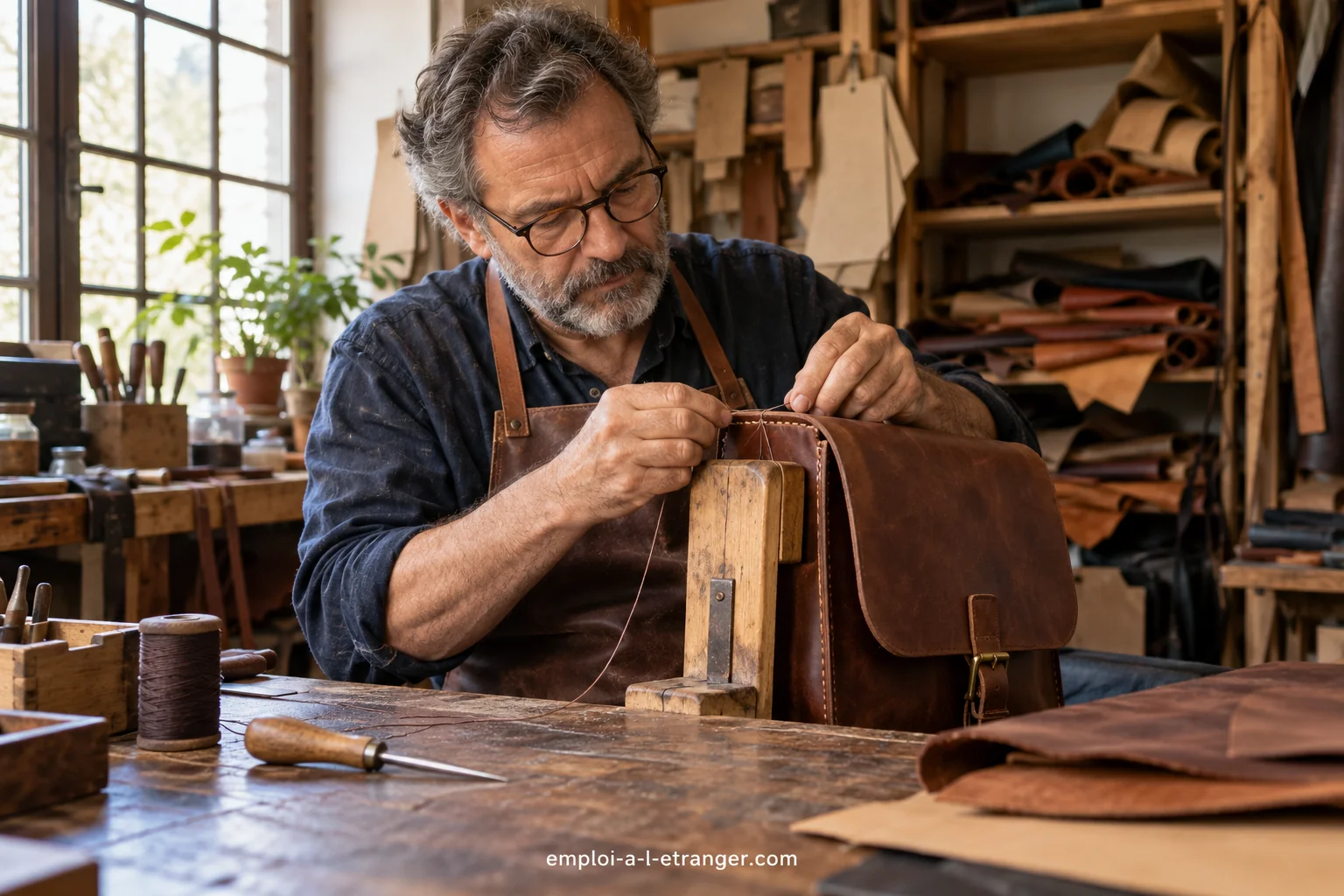
What a leatherworker can do, step by step
Leatherwork breaks down into distinct skills: choosing the hide, cutting, skiving, preparing the edges, assembly, hand or machine stitching, edge dyeing, fitting hardware and finishing. Some workshops expect a maker able to produce a complete bag; others look for a specialist in a single operation, repeated with great consistency.
In your application, name the stages you truly master and those you have only watched. Recruiters prefer an honest, precise profile to a list of skills that cannot be checked. Being straightforward also avoids an awkward gap between your claims and your performance in the practical trial.
A portfolio meant for close inspection: pieces, photos and short videos
Choose a few pieces you are allowed to show and photograph them in natural light, with close-ups of stitching, edges, corners and closures. An even saddle stitch, a smooth edge and a crisp fold are signs that professionals recognise. Avoid retouching that hides flaws: the workshop will see them in the trial anyway.
A short video of an edge being prepared or a seam stitched by hand can round off the file, as long as it is filmed without noise or cuts. State the time taken, the material and the tool used. If a piece belongs to a brand, do not publish it without written permission.
- Close-up photographs of stitching and edges
- Description of the material and the making time
- Clear line between personal pieces and workshop production
- An example of repair or restoration work
- List of machines and tools you master
Craft studio, luxury house or subcontractor: three different worlds
A small craft studio expects versatility and initiative: you might take part in design, making and dealing with customers. A luxury house values repeatable technique and strict standards. An industrial subcontractor prioritises output speed, with machines and batch quality checks.
Groups such as Hermès, Kering or LVMH describe their training routes and workshop trades on their careers pages. Their selection processes often include a practical test and several interviews. Read these pages to learn the vocabulary expected, without assuming that a post is open abroad.
Getting through a practical workshop trial
The trial is there to observe your speed, precision and the way you organise yourself. Ask in advance about the time allowed, the model to reproduce, the tools supplied and the marking criteria. If the trial lasts several days, check whether it is paid and under what legal framework it takes place.
During the test, ask questions instead of guessing: thickness of the hide, direction of the grain, finish expected. A leatherworker who checks before cutting inspires more confidence than a candidate who rushes. Keep your workstation tidy and note what was asked of you so you can learn from it.
Materials, finishing products and workshop safety
Leatherwork involves extremely sharp blades, skiving and sewing machines, glues, solvents and dyes. Ask which rules govern their use, what ventilation is provided and which personal protection is supplied. Some substances are regulated differently from one country to another.
Raise the question of raw materials too: where the hides come from, traceability requirements, the types of leather used, and exotic skins that need permits. This matters for ethics as much as for legality, particularly when items are exported or carried across borders.
Learning on the job: in-house training and progression
Every workshop has its own habits, patterns and tricks. Even if you are experienced, you will have to learn its way of doing things. Ask who will guide you during the first weeks, how your work will be checked and whether progression to more complex pieces is planned.
Serious in-house training sets out stages, goals and a named mentor. It also leaves time to correct defects before pieces go to the customer. If an employer promises you major responsibility straight away with no adaptation phase, ask how the workshop is really organised.
Pay, design rights over models and exclusivity
Depending on the country, a leatherworker may be paid by the hour, the month or the piece. Piece rates call for particular care: agree the price of each model, what happens to rejected pieces and the learning time for new items. Without clear rules, a complex model can cost you more time than it earns.
If you create prototypes or patterns, ask who owns them and whether you may show them in your portfolio. Some contracts impose exclusivity or a non-compete clause. Read these clauses carefully and have them translated if necessary before you sign.
Work authorisation and preparing the move
A craft trade does not exempt you from formalities. Your right to work depends on your nationality, the country and the type of permit required. For artisans, some countries have specific schemes; others treat this profile under general categories. Ask the competent administration before you sell your equipment or give up your home.
Plan how to transport your personal tools, often valuable and carefully sharpened. Check customs rules on blades, machines and animal materials, which may be inspected on arrival. Keep the invoices to prove where the equipment came from and to make a possible return easier.
Frequently asked questions
Do I need a leatherwork qualification to be hired abroad?
Not always. Many workshops judge the quality of your hand first, checked through a practical trial. A recognised diploma or training is still an asset, especially in large houses. State your years of experience, the products made and your references so your profile is easy to read.
How can I show my designs without betraying a former employer?
Show only personal pieces or work whose publication is authorised in writing. For workshop production, describe the technique without publishing protected models or brand names. If in doubt, ask the former employer for permission or replace the piece with an equivalent personal one.
Is an unpaid practical trial normal?
Practice varies by country and by company. A short, supervised trial limited to one exercise is common. A long unpaid period is questionable. Ask about the duration, the purpose and the legal framework before you turn up, and refuse to make pieces intended for sale.
Where can I look for leatherworker jobs outside my home country?
The careers pages of large groups such as Kering Talent or LVMH Careers present their workshop trades, and Hermès describes its craft know-how. Add craft networks and schools in the target country. Check the identity of any recruiter before sending your file.