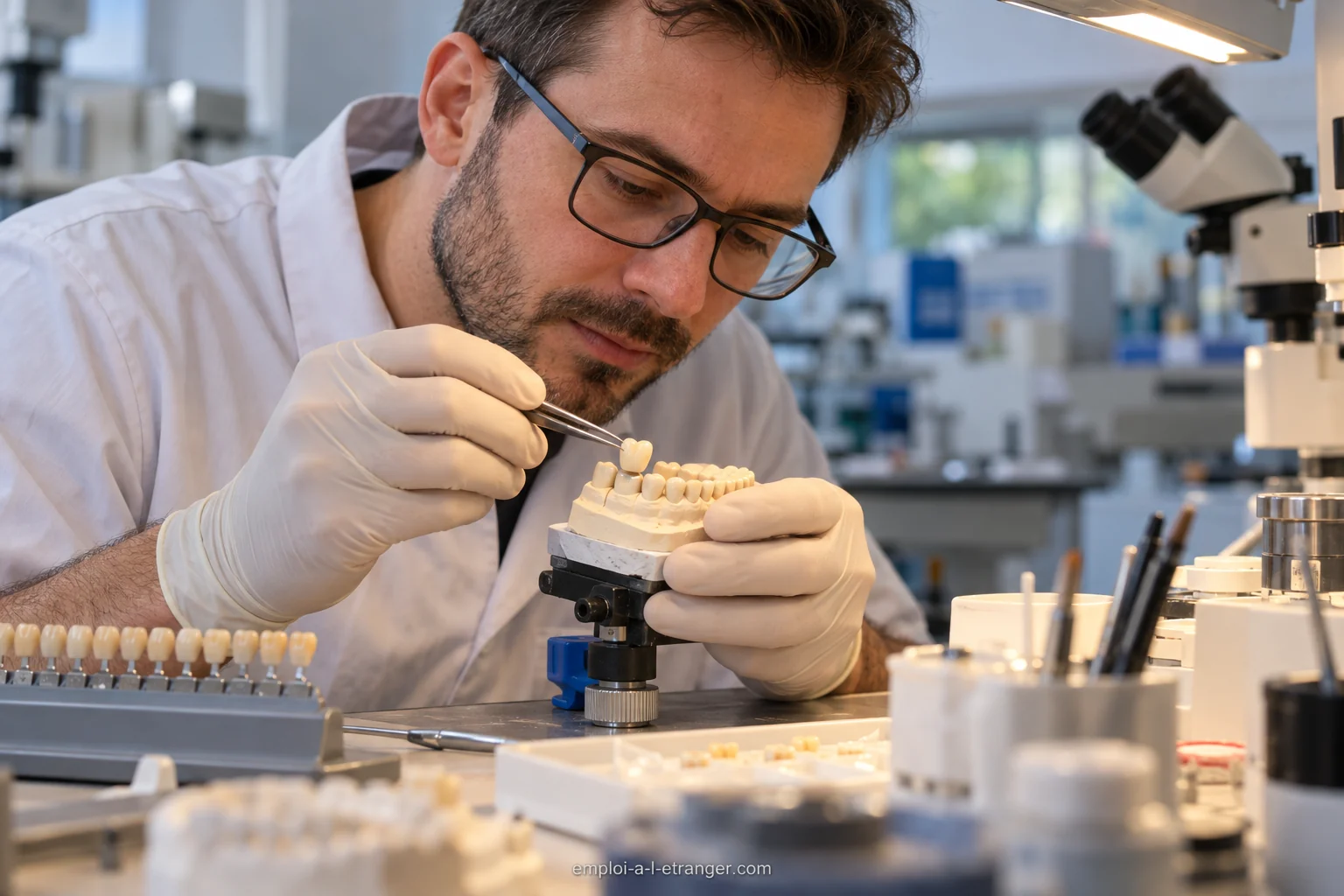
A precision trade, an application that shows real work
The dental technician designs and makes crowns, bridges, removable dentures and appliances from the impressions and instructions of the dentist. The result has to fit in the mouth to a fraction of a millimetre. That is why a recruiter abroad judges first on concrete cases, more than on a list of general skills.
Build a portfolio of anonymized cases: before and after photos, materials, fabrication steps, quality control. Remove any detail that could identify a patient. For each case, explain the difficulty you met and the decision you took; this reveals your reasoning, which a final result alone cannot show.
- Anonymized cases with photos
- Materials and processes used
- Checks before delivery
- Difficulties met and solutions
Specialties: ceramics, resin, metal, implants
Laboratories are often divided by specialty. Some make aesthetic ceramics for visible teeth, others focus on removable dentures, orthodontics or implant-supported prosthetics. A post for a ceramist is not the same as a post for a polisher or a model maker.
State clearly where your strength lies and what you master less well. Naming your specialty precisely attracts laboratories that need it and keeps you from ending up on tasks far from your experience. If you want to move toward another specialty, say so and explain what you plan to learn.
Digital design: more than knowing the software
Laboratories are adopting computer-aided design, milling and 3D printing. A candidate should name the software and machines used, but that does not describe real know-how. Explain how you check a file, adjust a design and verify the result before it goes to the dentist.
Say whether you have worked with intraoral scanners, open or closed systems, and which materials were milled. The differences between manufacturers are significant. A laboratory running a particular production line will appreciate someone who can adapt quickly, or who is willing to follow the supplier’s training.
Communicating with the dentist when an order is incomplete
An order can arrive with no shade specified, a blurred impression or a contradictory instruction. The technician then has to contact the practice, ask the right questions and record the answer. This ability to clarify prevents costly remakes and protects the relationship with partner practices.
Prepare an example for the interview: an ambiguous prescription you had clarified, what you asked, what happened next. If you work in a foreign language, make sure you master the technical terms. A vocabulary mistake about a shade or a shape can affect the final result.
Professional title and regulation by country
The status of dental technicians differs between countries. In some, registration with a regulator is required, such as the General Dental Council in the United Kingdom for dental professionals. In others, fabrication is carried out without a register but under the responsibility of a declared laboratory.
Ask the competent authority of the target country before applying: is your diploma recognized, is registration compulsory, how long should you allow? Do not count on the employer to sort everything out if it has never hired a foreign professional. Keep the answers in writing to support your file.
Laboratory organization: lead times, traceability, outsourcing
Ask how the laboratory receives, records and follows each order. Traceability of materials and finished devices is a central requirement in this sector. A good laboratory can tell which batch of material was used for which job, and who validated each step before dispatch.
Find out the usual lead times, the busy periods and how tasks are shared when work runs late. When part of the fabrication is outsourced, for example milling in an outside centre, who takes responsibility for a defect? These questions reveal how serious the organization is and prepare a smoother working relationship.
Large groups and small laboratories: two ways of working
International dental manufacturers and groups, such as Dentsply Sirona or Envista, recruit for technical, sales or training roles. Their organization is structured, with strict procedures. Working in an independent laboratory generally offers more versatility and direct contact with dentists.
Choose according to your profile: do you like specialization and standards, or variety and autonomy? In a small laboratory, responsibilities sometimes extend to client follow-up and stock management. In a large group, progression often comes through internal training and changes of site.
To decide, ask to visit the laboratory or, failing that, to see the workshop by video call. Look at how the workstations are arranged, the lighting, the condition of the machines and the cleanliness. These clues say a lot about the quality expected, and they help you picture daily life before you commit to moving.
Contract, tools and working conditions to verify
Before accepting, ask for the list of equipment available: furnaces, milling machines, printers, scanners, software. Check whether you must bring your own instruments and whether training on the machines is planned. A post without suitable tools prevents you from practising the trade despite your skills.
Read the contract too: hours, overtime, insurance, products handled, protective equipment. Dust, resins and some alloys require ventilation and protection. A serious employer sets out these points in detail. If it avoids the question of safety, that is a signal worth taking seriously.
Frequently asked questions
Do I have to be registered with a body to work as a dental technician?
It depends on the country. Some require registration with a health authority, while others regulate the laboratory rather than the individual. Ask the competent body of the target country before applying, and ask in writing whether your diploma is recognized and which steps the employer can help with.
How can I show my work without breaching confidentiality?
Anonymize each case: no face photos, no names, no dates of birth, nothing that could identify the patient. Present the material, the fabrication steps and the checks. If a practice entrusted the work to you, check that its policy allows you to show it before you publish.
Is digital design essential to find a post?
It is increasingly requested, but many laboratories still value manual skill, especially in ceramics and removable dentures. Mention the software and machines you use, while showing that you can check a result and correct a design.
How can I judge whether a foreign laboratory is reliable?
Look at its legal existence, its traceability procedures, its equipment and how it handles delays and remakes. Ask to speak with a current employee and to read the contract before committing. A laboratory that refuses these checks offers few guarantees.