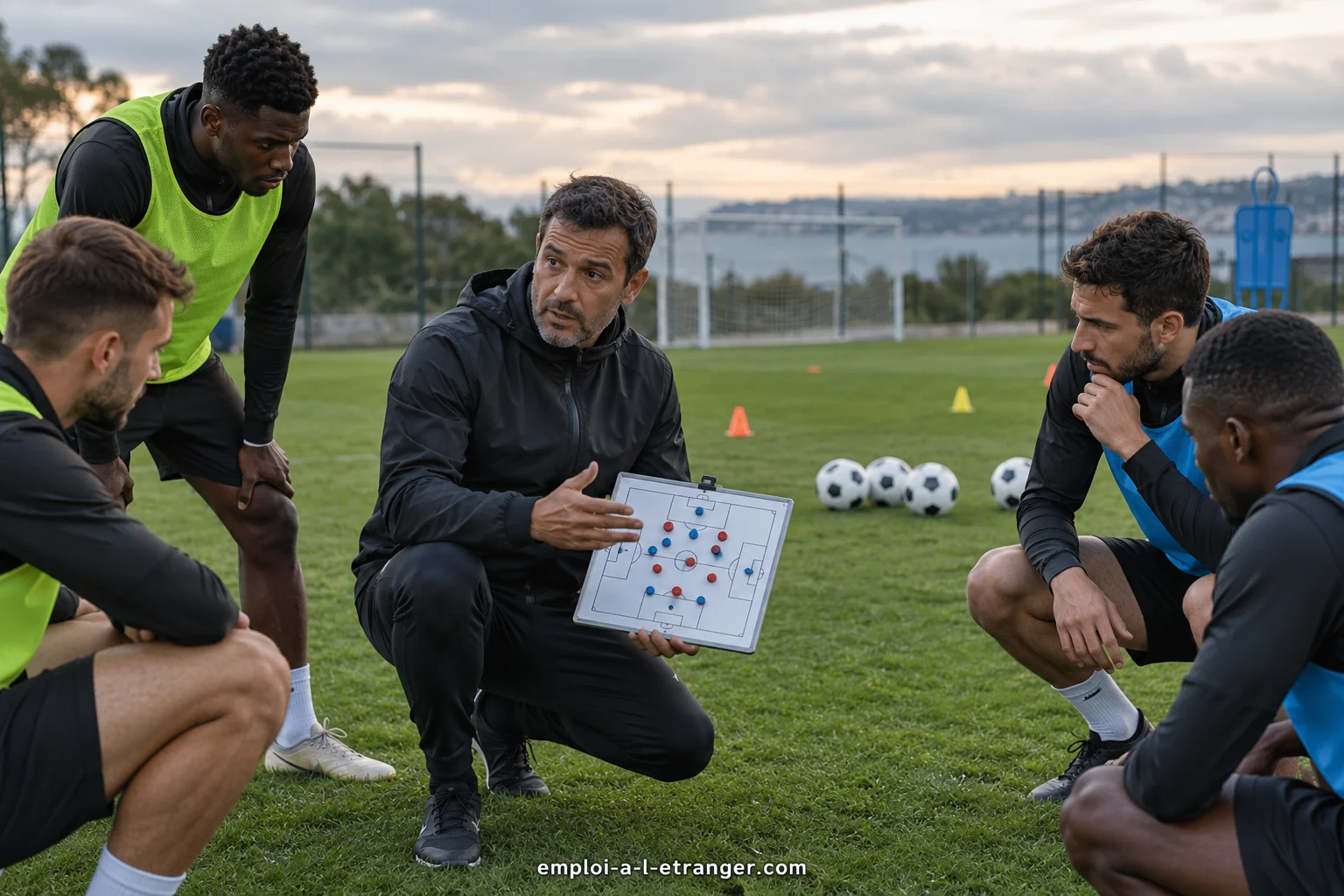
What a club abroad expects from a coaching candidate
A club recruiting beyond its borders first looks for someone who can deliver progress, not just a name or a playing career. It reads your application with three questions in mind: what playing philosophy do you stand for, how do you pass it on every day, and can you make it work in a new cultural and linguistic setting?
The post you are aiming at varies a lot from one club to another. A youth academy asks for teaching skills and individual follow-up, an amateur club wants an all-round coach who also handles logistics, and a professional set-up looks for a precise specialism. Decide which kind of job you mean before applying, because the same letter does not suit all of them.
- A written, defensible game philosophy
- Training sessions described, not just listed
- Enough language skill for the dressing room
- A coaching licence or diploma whose value is confirmed
The game model: the document that opens the conversation
Write a game model of two to four pages. It sets out your preferred shape on the pitch, your principles in attack and defence, your transitions and your set pieces. Show too how the model adapts when the squad does not fit it: a club short of a striker who runs in behind needs to see that you can adjust.
Illustrate each principle with a sample session: objective, duration, number of players, instructions and success criteria. Avoid diagrams copied from a manual, since a recruiter quickly spots a generic document. A short model tied to real situations is worth more than a theoretical treatise that nobody reads to the end.
Proving your coaching experience, age group by age group
Describe each experience in the same form: club, age group, level of competition, squad size, length of time and place in the staff. An assistant coach of an under-15 side and the head of a reserve team do not carry the same responsibility, and a club abroad wants to know without guessing.
Add evidence of follow-up: player assessment sheets, a group’s progress over a season, players moving up to an older category. These traces describe your method better than any adjective. If you worked with a fitness coach, a video analyst or a specialist goalkeeping coach, explain how you shared the tasks, because it shows you can work in a team.
Diplomas and licences: confirm recognition before you apply
Coaching qualifications are issued by national federations, with levels modelled on UEFA frameworks but not always identical from one country to another. Your home licence, for example, does not automatically carry the same rights on the bench of a foreign club, especially in top-level competitions.
Write to the federation of the target country, or ask the club to do so, to find out which licence is required for the category concerned and whether yours is recognised. Note the reply and keep it. Never present an equivalence as settled until it is confirmed in writing: a club can be penalised if its coach is not authorised to act.
- Exact name of your diploma and the body that awarded it
- Programme followed and volume of training
- Written request to the federation concerned
- Reply kept on file with its date
Clarify the scope of the job before any negotiation
A coaching offer sometimes covers very broad duties: sessions, recruitment, opposition scouting, contact with families, kit management and travel. Ask what falls to you and what belongs to the sporting director or the club officials. Misunderstandings almost always come from a vague remit.
Ask practical questions as well: number of sessions per week, access to pitches and the gym, available equipment, medical staff and the language of meetings. The advertised sporting level says nothing about these conditions. A prestigious club may offer little to its youth staff, while a small, well-organised club may let you work in better conditions.
Working with minors: obligations and caution
If the job involves children or teenagers, the club should be able to explain its safeguarding policy. Many countries require a background check or a certificate before you can work with minors; the procedures vary. Find out what will be asked of you and how long it may take.
For your own portfolio, use only photos or videos that you are allowed to share, and hide the identity of minors unless the parents or guardians and the club concerned have agreed in writing. A training video published without safeguards can harm you more than it helps, especially with a recruiter who pays attention to these matters.
Status, contract and residence to confirm
A coach’s status varies: club employee, self-employed contractor, volunteer with expenses, sometimes attached to a non-profit body. Each case brings different obligations for social protection, tax and the right to stay. Ask for the proposal in writing and check who the legal employer is.
If your nationality does not give you the right to work in the country, the club should be able to say which procedure it has in mind and with which authority. Consult the host country’s official information and do not leave on a verbal promise alone. Plan a settling-in budget that does not depend on an administrative decision you are still waiting for.
Where to find vacancies and how to sort them
Offers circulate through several channels: federation and club websites, publications by coach education bodies, sports job platforms and professional networks. The careers sections of FIFA or the UEFA pages for coaches give an idea of the profiles being sought, without replacing a direct approach.
Sort adverts by three criteria: how reliable the organisation is, how clear the job is and how well it matches your qualification. Be wary of middlemen who ask for money to place a coach: a serious club does not charge the candidate. If in doubt, check that the club exists, that it is affiliated to its federation and that the person writing to you really works there.
Frequently asked questions
Is my home coaching licence valid in another country?
It depends on the country, the federation and the category you are aiming at. Training levels look alike but are not always equivalent. Ask the federation of the country concerned, in writing, which qualification is required and whether yours is recognised. Keep the reply before you sign anything with a club.
Do you need to speak the local language to coach a club?
It is not always required, but the language of the dressing room matters a great deal, especially with young players. Some clubs work in English, others only in the local language. Ask which language is used for sessions, staff meetings and talks with families, then assess your own level honestly.
Can you become a coach abroad without having been a professional player?
Yes, many coaches never had a professional career. Clubs look mainly at your training, your method, your coaching references and your ability to make a group progress. A precise game model and examples of player follow-up weigh more than a poorly documented playing past.
How can you avoid fake job offers in football?
Refuse to pay for a post or a trial, check that the club exists and is affiliated to a federation, and verify the identity of the person contacting you. Ask for a written contract setting out duties, length and conditions. An urgent promise with no document and no identifiable contact should alert you.