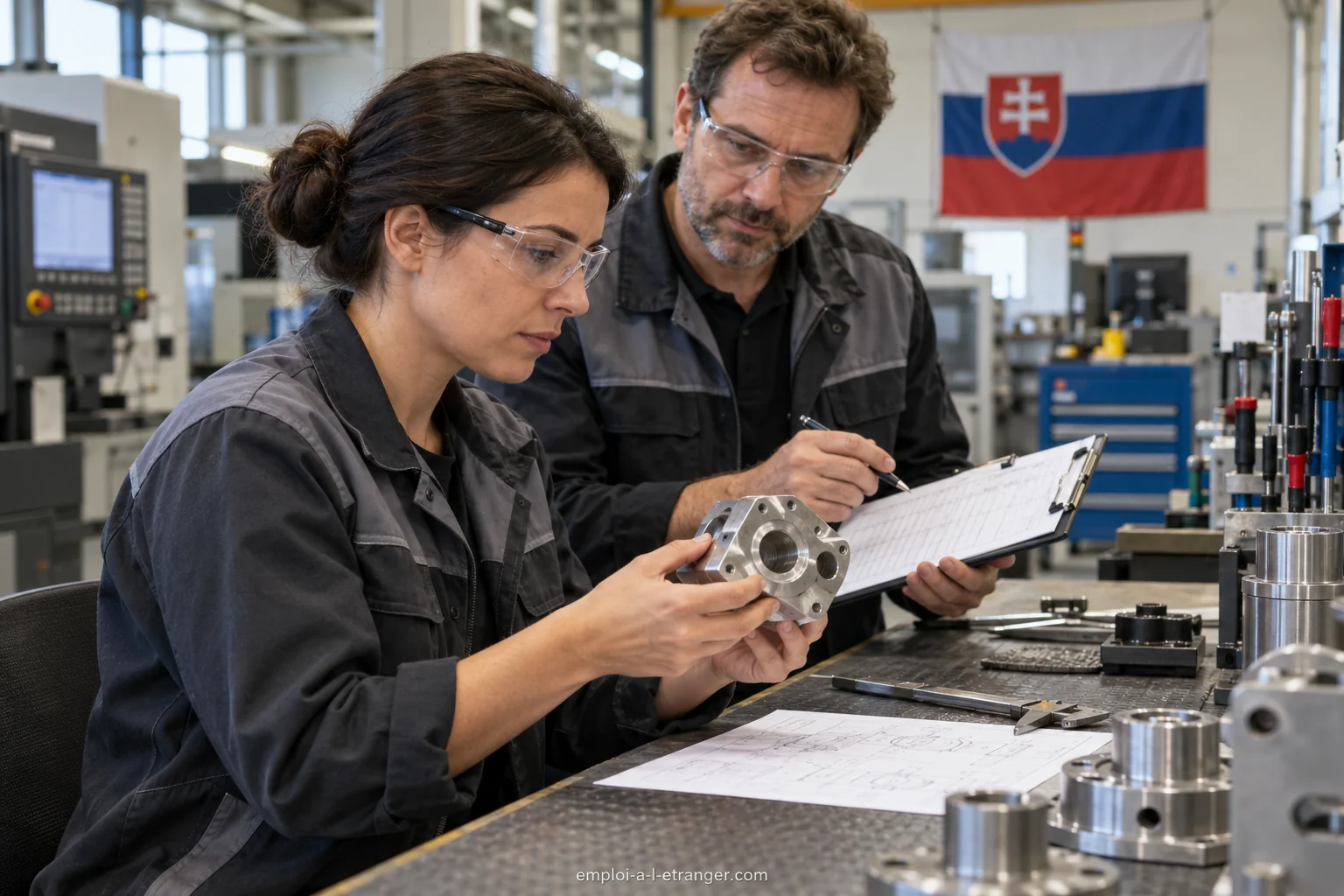
Which language is really spoken on the job in Slovakia?
Many offers aimed at foreign candidates are written in English, sometimes in German. That does not guarantee that safety instructions, team meetings and talks with supervisors take place in the same language. On a production site, Slovak often dominates on the shop floor.
Ask three questions: in which language are the work instructions written, which language does your direct manager speak, and how many colleagues speak a language you know well. The answers measure your future independence better than a language level quoted in the advertisement.
Building trade vocabulary before you leave
Targeted vocabulary beats general study. List the tools you use, the operations you carry out, quality checks, safety instructions and the faults you will have to report. Look for the Slovak equivalents, or at least the terms the team uses in English.
Note also the abbreviations and acronyms specific to the company: part numbers, defect codes, job names. They are learned quickly when you spot them from the start, and they spare you from depending on a colleague to translate every instruction.
Have this list checked by someone at the company if possible. They will correct the technical words and tell you which expressions are used on site. This effort shows you are serious, speeds up your integration and reduces the risk of errors in the first weeks, when you do not yet dare ask for explanations.
- Names of tools and machines
- Safety instructions and incident reporting
- Inspection and quality terms
- Phrases for talking with supervisors
The paperwork to gather before you travel
Do not leave without the proposed contract, the exact address of the workplace, and the name and phone number of the person who will meet you. Add the first week’s schedule, the start time and the meeting point. Keep this information on paper and on your phone, with an offline copy.
If the employer has arranged accommodation, ask for the address, how long it is provided and any cost. Temporary housing can become a problem if no follow-on arrangement exists. Find out too how your first pay works, as it can be spread out according to the company’s internal practice.
The first days and the daily commute
Ask how the welcome, the site tour, the issue of equipment and the induction training will be organised. A well-run employer gives a precise programme. A vague answer does not prove bad faith, but it is a reason to ask more questions before booking a journey.
Find out also about the route between your home and the workplace. Some sites are far from towns and served by organised public transport or shuttles. Others require a private vehicle. Consider night-shift or weekend hours, which often make travel harder.
Checking the offer with public employment services
The public jobs portal and the network of employment services provide information on the Slovak labour market. ÚPSVaR, the Office of Labour, Social Affairs and Family, sets out some of the rules for foreign workers. Use these sources to compare the advertisement with official benchmarks.
The IOM’s migration information centre, run by the International Organization for Migration, offers guidance for people preparing to work abroad. It does not replace an authority’s answer on your case, but it helps you formulate relevant questions for the employer.
European Union citizens and nationals of other countries: two situations
The rules on residence and work are not the same for a European Union citizen and for a national of a non-EU country. The first benefit from free movement, with registration formalities that may apply after a certain length of stay. The second generally have to obtain authorisation before working.
In every case, check your situation with the Slovak authorities or their representation. Procedures change, and information read on a forum may be out of date. Ask the employer what it takes care of, what it expects from you and by what date your file must be complete.
Agencies and intermediaries: who is the employer?
Many industrial jobs are offered by temporary-work or recruitment agencies. Identify the entity that pays you, the one that supervises you on site and the one that answers in a dispute. These three can be different, and the split of responsibilities must be in writing.
Refuse to pay money for a place or a visa promise. Check the company’s name and contact details and whether the advertisement matches the contract. A serious agency gives you an understandable document before you leave and lets you reread it or have it translated.
Questions to ask in the first conversation
Prepare five simple questions: what is the make-up of the team, who supervises me, exactly which tasks will I be given, what is the schedule for the first weeks and how are exchanges organised when I run into a problem. Listen to how precise the answers are rather than how fast they come.
Note also what the employer does not tell you. If pay, hours or contract length stay vague after several requests, treat it as a signal. A serious project can stand up to questions, and will help you decide on solid ground rather than on the enthusiasm of a first interview.
Frequently asked questions
Can you work in Slovakia speaking only English?
In some international companies, yes, especially for technical, IT or management roles. For a workshop or service job, Slovak is often needed day to day. Ask which language the instructions and supervisors use, then learn the basic vocabulary of your trade before you arrive.
What should you ask an agency offering a job in Slovakia?
Ask for the identity of the real employer, the work address, the full contract, the pay, the hours and the housing conditions. Check that the agency exists and that its contact details are consistent. Pay nothing until you understand who employs you and who answers if there is a problem.
Which documents should you carry on the first trip?
Keep a valid ID, the contract or written offer, the work address, the contact details of the person welcoming you and the documents the employer requests. Also keep digital copies available offline, and useful phone numbers in case of delay or the unexpected.
Where can I check the residence and work rules for my nationality?
Consult the official websites of the Slovak authorities, the ÚPSVaR labour office and IOM guidance. Contact the country’s representation to confirm your case. Rules change with nationality and type of activity, so check at the source before you commit.