Operator, setter or programmer: place your level of independence
The word machinist covers very different responsibilities. The operator loads parts, starts cycles and inspects. The setter prepares the machine, mounts tools, sets the work offsets and adjusts parameters. The programmer writes or modifies programs, sometimes from CAM software. Each stage calls for a different degree of independence.
Do not try to place yourself at the highest level if your practice is closer to setting. A foreign workshop often checks during a trial. Describe what you did alone, what you did with a team leader, and how you reacted when a dimension drifted.
- Running the machine
- Setting up and finding work offsets
- Shop-floor programming
- Inspection and batch follow-up
Naming the machines, controls and materials
A technical recruiter first reads the machine park: lathes, three- or five-axis machining centres, sliding-head lathes, wire and sinker EDM. Cite the makes and CNC controls you have really used, because the interface logic differs from one builder to another and switching takes adaptation.
Add the materials you worked: steels, stainless, aluminium, titanium, engineering plastics. Each imposes its own tools, speeds and precautions. A machinist who has cut difficult alloys should say so, with the type of part and the sector, without revealing confidential information from the employer.
Drawings, tolerances and dimensional checks day to day
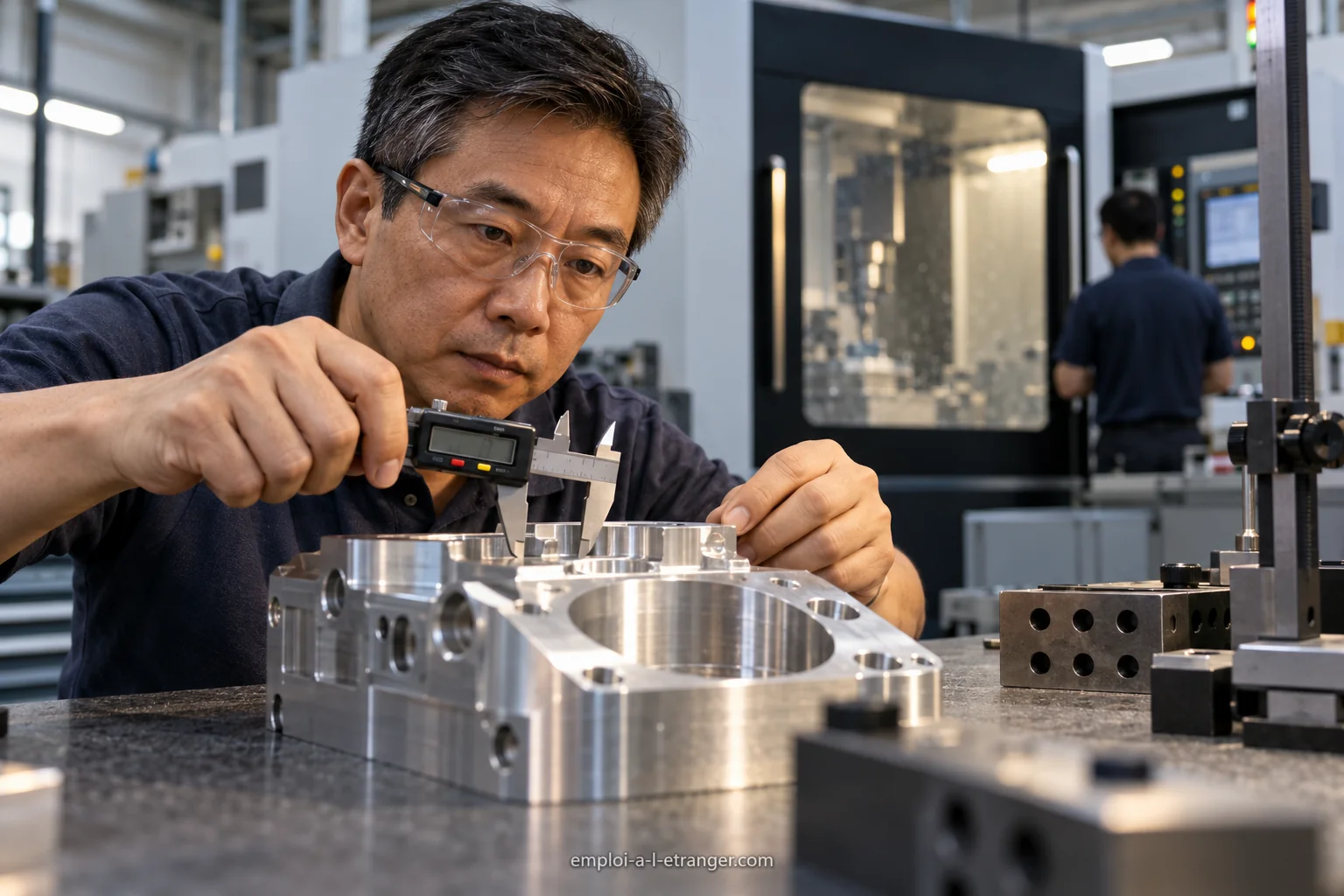
Drawing reading is a decisive criterion. Say whether you work with geometric tolerances, required surface finishes and functional dimensions, and which instruments you handle: calliper, micrometer, dial gauge, roughness tester, coordinate measuring machine. State whether you write the inspection reports.
Tell how you deal with a deviation. Spotting a drift on the fourth part of a batch, measuring tool wear, correcting an offset and isolating the doubtful parts are actions that reassure. The employer then sees a professional who protects quality rather than a mere cycle operator.
Finally, mention your ease with inspection and simulation software, for example to check a program before running it. Simulation prevents costly collisions, and an employer sees it as the mark of a careful machinist who protects the machine, the tooling and the material before the first chip is cut.
Batch size, traceability and quality requirements
One-off or small-batch manufacturing is not like repetitive production of thousands of parts. In the first case, setting and flexibility dominate. In the second, process stability, cycle rate and inspection discipline matter more. Ask which type of workshop you would be assigned to.
Ask about traceability too: material lots, routing sheets, inspection records, signatures. Some sectors, such as aerospace or medical, impose strict follow-up. If the company works to a recognised quality system, ask what it expects from an operator and what training you will receive.
A foreign workshop may also ask about your relationship with documentation: do you read a process plan on your own, fill in a non-conformance report, know how to flag a material anomaly? These habits count in sectors where every part is tracked, and they distinguish a reliable operator from one who is merely fast.
Aerospace, general engineering or tooling: three workshop cultures
Aerospace demands procedures, manufacturing files and a high level of paperwork discipline. General engineering often favours responsiveness and versatility with varied customers. Toolmaking, moulds or fixtures call for great care over precision and are often one-off work.
Match your experience to the workshop you are targeting. An aerospace machinist applying in general engineering must show acceptance of shorter lead times. The reverse must prove they can meet demanding documentation. This honesty helps both sides, because a mismatch of expectations is the most common reason a promising placement ends within the first few months, and it is far easier to discuss before the contract than after it.
Shift work, first-level maintenance and safety
Many workshops run two or three shifts to make the machines pay. Ask for the exact rotation, how often nights occur, the compensation and whether a day schedule is possible. Have it specified who does routine upkeep: cleaning, lubrication, tool replacement, or a dedicated maintenance department.
On safety, look at machine guarding, protective equipment, handling of chips and cutting fluids. Ask concrete questions about the company’s safety induction. A serious factory presents its rules during the visit and does not keep them for a document signed on the first day.
Finally, ask how the workshop handles machine breakdowns and priorities between urgent batches. In a small company, the machinist may be asked to change workstation at the last minute, whereas a large plant follows more rigid scheduling. This expected flexibility directly affects your workload and your tiredness over time.
Finding a workshop and building a technical file
Major contractors such as Safran, Fives or Airbus publish vacancies on their careers pages, but many jobs are with regional subcontractors, advertised in the local language. Search with the technical terms used in the country to widen your search, and look at local industry associations.
Prepare a sober file: a CV centred on machines, photos of non-confidential parts, drawing extracts if your original employer allows it, training certificates and references. Entry and work conditions depend on your nationality and the country, and should be checked with the competent authority before any departure.
Frequently asked questions
Do I need to know how to program to find a CNC machinist job abroad?
Not always. Many jobs involve running and setting machines that are already programmed. Shop-floor programming is nevertheless an asset, notably in small companies. State in your file what you write, modify or correct yourself, and on which CNC control.
Can a foreign employer test my skills before hiring me?
This is common. The trial may take the form of a drawing-reading exercise, a part inspection, a technical discussion or a session on a machine. Find out how long it lasts, whether it is paid and which safety rules apply before you attend.
Is my experience on one make of CNC control transferable?
Largely, because the principles of machining stay the same: offsets, tool compensation, cycles, inspection. The interface does change from one builder to another, though. State the controls you know and ask whether a familiarisation period is planned on the workshop’s machine.
What should I ask about shift work before signing?
Ask about the rotation system, the number of consecutive nights, rest days, any bonus and how replacements are handled. Also check transport times from your housing. Have these elements written into the contract or an internal rulebook handed over in writing.