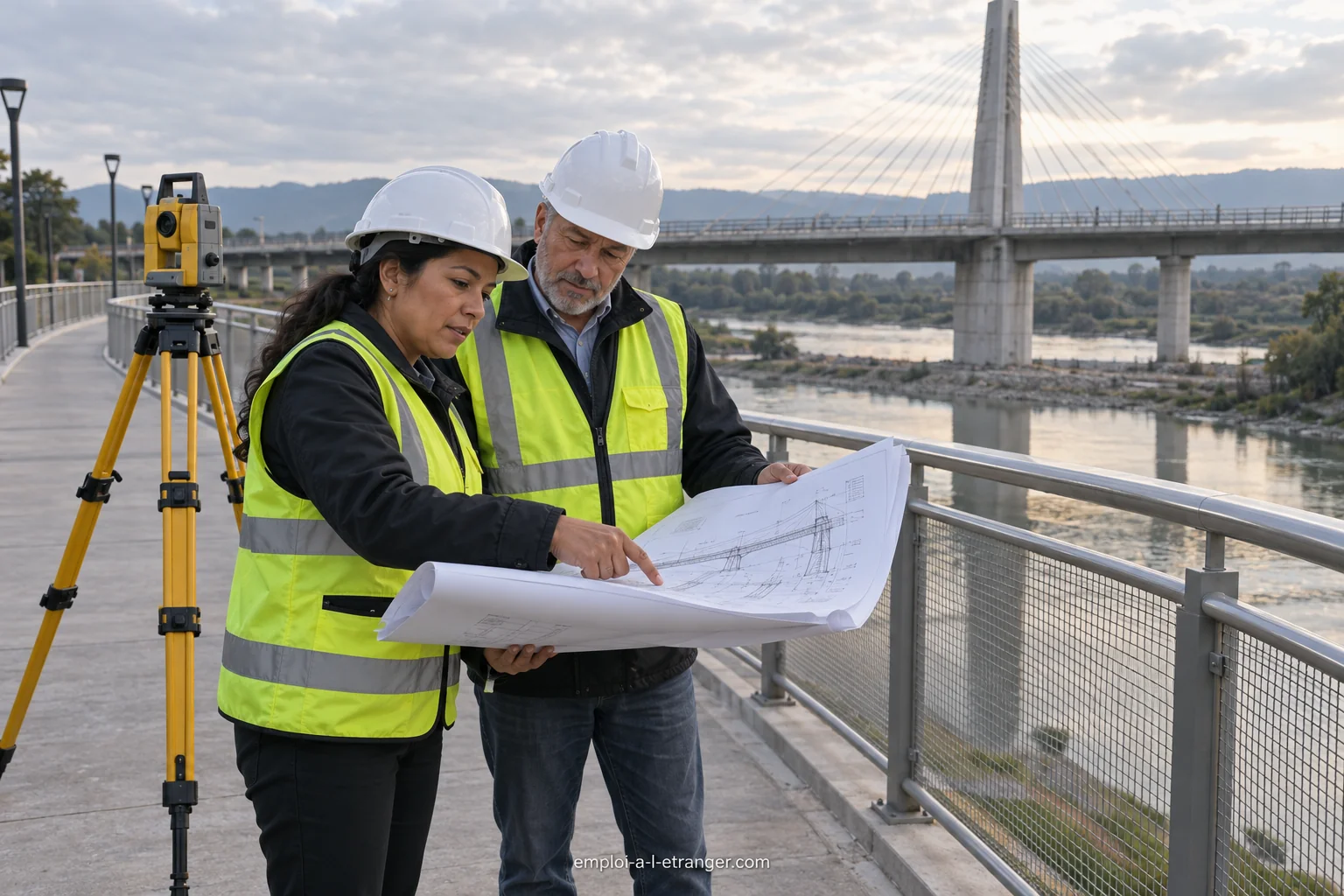
Place your role in the chain of a project
A structure goes through briefing, design, project supervision, construction and operation. A civil engineer can work at any stage: calculating a structure, coordinating contributors, following a site, checking compliance or carrying out an expert appraisal after a defect.
In an international application, say precisely where you fit. List the types of structures you have handled (buildings, bridges, roads, hydraulic works, foundations), the phase you followed and your level of responsibility. A recruiter abroad may not know your national job titles and reads mainly what you actually did.
An international recruiter also likes to know how you handle uncertainty: partial geotechnical data, drawings changed late, unavailable materials. Prepare an example in which you documented your assumptions, informed the stakeholders and proposed a fallback solution.
- design and structural calculations
- project supervision and coordination
- site execution follow-up
- expert appraisal and structural diagnosis
Explain your reasoning, not just your software
Calculation and drawing software are expected tools, but they do not prove the quality of an analysis. For a given structure, explain the assumptions you adopted, the loads considered, the checks carried out and the choices that changed during the design.
Show also how you dealt with a gap between the calculation and reality on site: soil different from forecasts, a site constraint, a change to the brief. This ability to adjust your reasoning is what separates a software operator from an engineer.
Working with other disciplines
A successful structure depends on exchanges between structural, geotechnical, hydraulic, electrical, architectural and environmental teams. Describe a situation in which you had to arbitrate between conflicting requirements, for instance an opening that weakens a load-bearing element, or a programme that forces certain orders to be placed early.
Abroad, these exchanges take place in several languages and with different documentation habits. State the drawing formats, levels of detail and approval routes you know, as well as your experience of shared modelling between teams.
Finally, prepare an example of coordination with a local engineering firm, because many international projects pair a foreign consultancy with a local team in charge of regulatory compliance and relations with the authorities.
- arbitration between disciplines
- drawing and report formats
- document approval routes
- shared modelling of the structure
Design codes and approval procedures: nothing transfers automatically
Design rules, safety factors, climatic loads and seismic loads vary from country to country, even within families of similar standards. An engineer who is competent in Europe has to relearn the framework that applies in the Americas, the Middle East or Asia.
Ask the employer about the standards in force, the training planned and who will check your first calculations. Never claim mastery of a code you have not used; it is better to declare a solid foundation and supervised progress.
To get up to speed, build a personal sheet comparing the codes you know with those of the target country: loads, combinations, materials, checks. Even a partial comparison shows that you are serious and helps you ask precise questions at interview. It also prepares your first weeks, when you will have to justify every choice to a technical manager who is not yet familiar with how you work.
Protected professional titles and signing documents
In several countries, only an engineer registered with a professional body or holding a licence may sign certain drawings or reports. An engineering degree obtained in your home country is not always enough; a recognition or registration procedure may be needed, with its own deadlines and conditions.
Before approving or signing a technical document, ask which checks apply. Get information from the local professional body and the competent authority, and never sign without knowing who bears legal responsibility for the structure.
- professional body or licence in the country
- recognition of a foreign degree
- person authorised to sign
- professional liability insurance
Office, site and the supervision available
The split between office and site varies greatly between jobs. Some engineers spend most of their time at a screen, others on site, with irregular hours, travel and sometimes accommodation in a site camp. Ask for this split and how it might change.
Ask about supervision too: a senior engineer available to review your work, an accessible technical manager, a mentoring framework. A junior engineer left alone on a complex project abroad is taking risks; an attentive employer always plans gradual support.
Ask whether the company arranges site visits before you take up the post, so that you can judge the working environment for yourself.
Contract terms and the engineering team’s responsibilities
Read the contract carefully: place of work, length of assignment, rotation, pay, travel allowances, insurance, repatriation and end-of-assignment conditions. For a project abroad, these points matter as much as the technical content.
Ask how responsibility is shared between the engineering team, the company and the client if a defect occurs. Some contracts include penalty or warranty clauses that commit you more than you might think. Have these clauses reviewed by a lawyer if necessary.
Searching among international engineering consultancies
Large groups such as Arup, AECOM or WSP post vacancies on their careers pages, with the location, the discipline and the level of experience. Smaller consultancies, construction companies and public clients also recruit internationally.
For each country, check the work authorisation required, the residence procedures, health insurance and housing conditions. Ask in writing what the employer covers, then confirm with the competent authority of the country before planning your departure.
Frequently asked questions
Is my engineering degree recognised abroad?
It is often well regarded in the private sector, but formal recognition depends on the country and the activity. To sign drawings or to practise under a protected title, registration may be required. Ask the professional body or authority of the target country.
Do I need to speak the local language to work on a construction site?
English is often the engineering language, but a site involves local teams, authorities and suppliers who speak the language of the country. A few basics, a reliable interpreter and solid technical vocabulary make the work easier and safer.
Can I move from a design office to site execution abroad?
Yes, but it means accepting a different rhythm and other responsibilities. Explain your motivation, your coordination skills and the safety training you have already completed. Ask to be supported by an experienced site manager or site engineer.
Which documents should I prepare for a civil engineering application?
A dated CV, a list of projects with your role, your diplomas, any safety training certificates and, if needed, a portfolio of non-confidential drawings or reports. Prepare translated versions if the recruiter asks, and keep your originals.