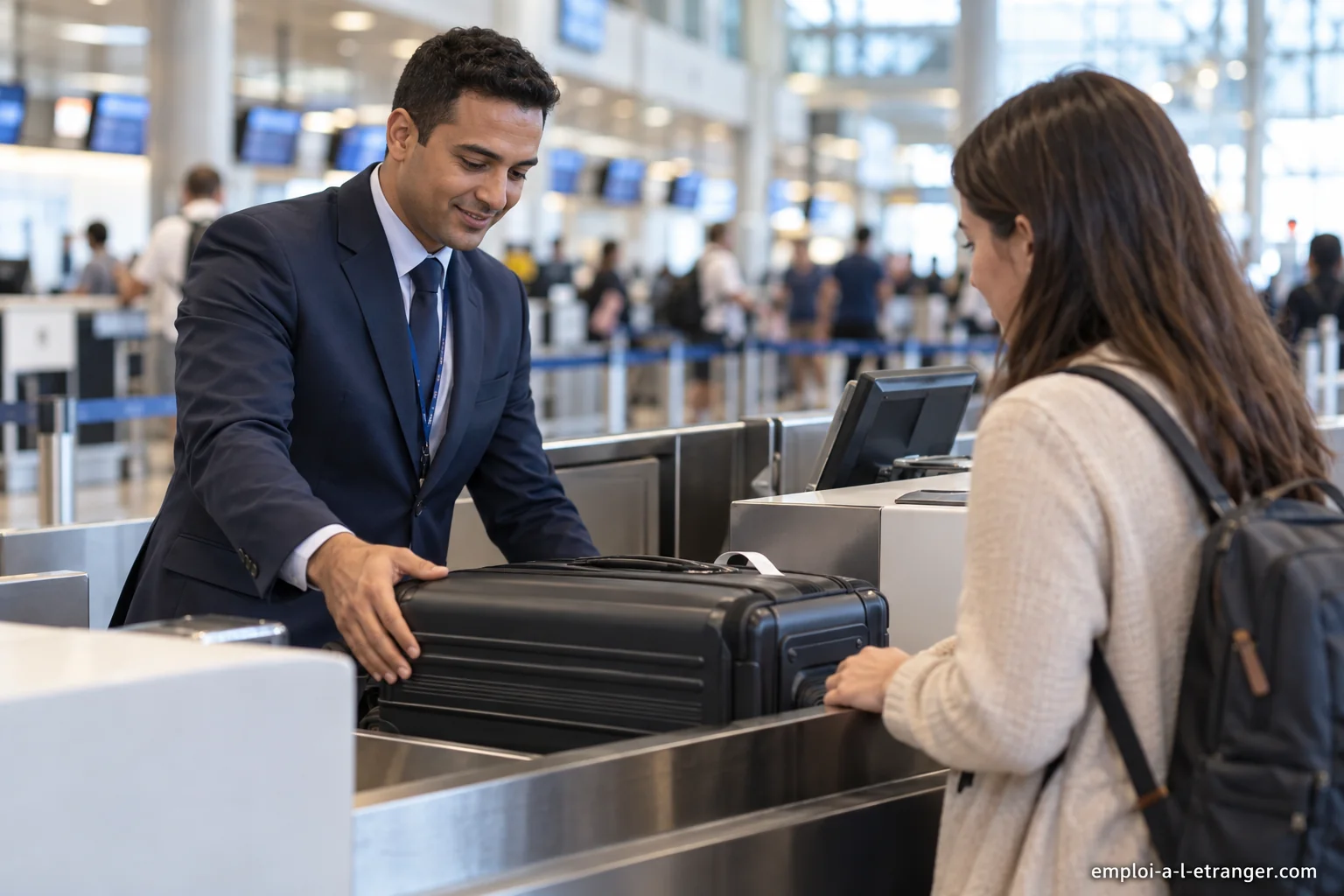
What does a ground agent actually do?
The ground agent welcomes travellers, checks in passengers and their baggage, checks travel documents, manages boarding and deals with unexpected situations: a delayed flight, a missed connection, lost luggage. They work with a computer system specific to the airline or the airport, and follow strict procedures.
Depending on the employer, you may be assigned to just one of these areas. Some posts are limited to the desk, others alternate between desk and boarding gate, and others cover assistance for passengers with reduced mobility. Read the list of duties to see which one matches your experience.
Airline or handling company: two possible employers
An airline may employ its own ground staff or entrust these tasks to a ground-handling company that works for several carriers. In the second case you will be assigned to flights of different airlines, with procedures specific to each and repeated training.
Groups such as Swissport, Menzies Aviation or dnata post their jobs on their careers pages. Always ask who the legal employer is, which customers you will serve and whether your contract depends on keeping a particular contract won. This detail says more about the stability of the job than any recruitment slogan.
Showing off your welcome skills, languages and composure
Your experience of dealing with the public, in hospitality, retail or transport, is a direct asset. Describe concrete situations: an angry customer calmed down, a queue managed at peak time, a complicated rule explained simply. Recruiters look for self-control as much as friendliness.
Be honest about your languages: a language you can read, understand or speak fluently does not open the same tasks. If you claim good English, expect an oral test or an interview in that language. Mention your ease with booking or check-in software too, if you have used any.
- Examples of welcoming people at times of heavy traffic
- Languages and your real spoken level
- Computer tools you have already used
- Teamwork with other departments
Unsocial, split shifts and public holidays
An airport runs early in the morning, late in the evening and sometimes all night, with marked seasonal peaks. Rotas are often given in advance but can change with flight rotations. Ask for the average length of a shift, how often weekends and public holidays are worked and the rest rules.
Find out about the journey between your home and the airport for a very early start or a late return. In some cities no public transport runs at those hours. This constraint affects both cost and tiredness, and is a reason to compare several places to live before you sign a lease. Ask also whether the employer runs staff transport for the earliest or latest shifts, which makes a real difference to daily life.
Access to restricted areas and prior checks
Working at an airport means obtaining access to areas where entry is controlled. The airport authority or the employer generally asks for proof of identity, a history of employment or residence over a given period, and sometimes a security investigation. Requirements change by country.
Ask at the outset for the list of documents to supply, the usual processing time and what happens to the employee during the process: training, waiting, a postponed start. Do not plan to move before you have a clear idea of how your file will turn out. These checks are never negotiable, whatever your experience.
Passenger service or ramp: do not confuse the two
The word ground covers two different worlds in practice. Passenger service takes place in the terminal, in direct contact with travellers. Ramp operations involve loading baggage and cargo, guiding aircraft and assisting on the ground, in a noisy, outdoor and physical environment.
An ad for a ground agent may hide either one. Ask the question straight out: where will you work, in what uniform, with what lifting of loads, how exposed to the weather? Tailor your application to one category or the other; a letter mixing both gives the impression that you have not understood the job. If you hesitate, ask for a day of observation or a detailed description of a typical shift, from the first task to the last.
Initial training and sector certifications
Employers generally train their agents on the airline’s procedures, security, handling dangerous goods and assisting specific groups of passengers. Ask how long this training lasts, whether it is paid and what happens if you fail the final assessment.
If you already have training for aviation jobs or a first-aid certificate, mention it. Give the dates obtained and the bodies that issued them. Avoid claiming qualifications you cannot justify: in a sensitive sector, background checks make any approximation risky for your application.
Getting settled near an airport
Areas near a large airport offer very uneven rents and journey times that cannot be read off a map. Compare several neighbourhoods, checking transport at unusual hours and the possibility of sharing a home for the first months.
Keep savings to cover the wait before your first salary, the deposit and transport costs. Ask the employer whether it offers relocation help or temporary housing, and get the answer in writing. A move prepared without rushing gives you a better chance of staying in the job.
Frequently asked questions
Do I need to speak several languages to become a ground agent?
Almost always the local language or English, and a third language is often an advantage. The level required depends on the job: an international desk demands good spoken expression. Read the ad, offer an honest assessment and be ready for an oral test during recruitment.
Can I apply from France for an airport abroad?
Yes, many recruiters accept remote applications and hold video interviews. However, access to restricted areas and the permission to work require steps to be taken locally or in the country. Ask the employer how the procedure works for a candidate arriving from abroad, which documents it wants before arrival and when the contract becomes final, so that you avoid booking a ticket too early.
Is the work of a ground agent physical?
At the desk it mainly means standing and occasionally lifting bags. On the ramp it is far more physical and takes place in all weathers. Ask how tasks are really divided, what equipment is supplied and what adjustments are possible if your physical condition sets limits.
What is the difference between a ground agent and a ramp agent?
The ground agent mostly looks after passengers in the terminal: check-in, boarding, assistance. The ramp agent works on the apron: baggage, cargo, support for the aircraft. Both sometimes depend on the same employer, but the skills, uniform and working conditions differ clearly.