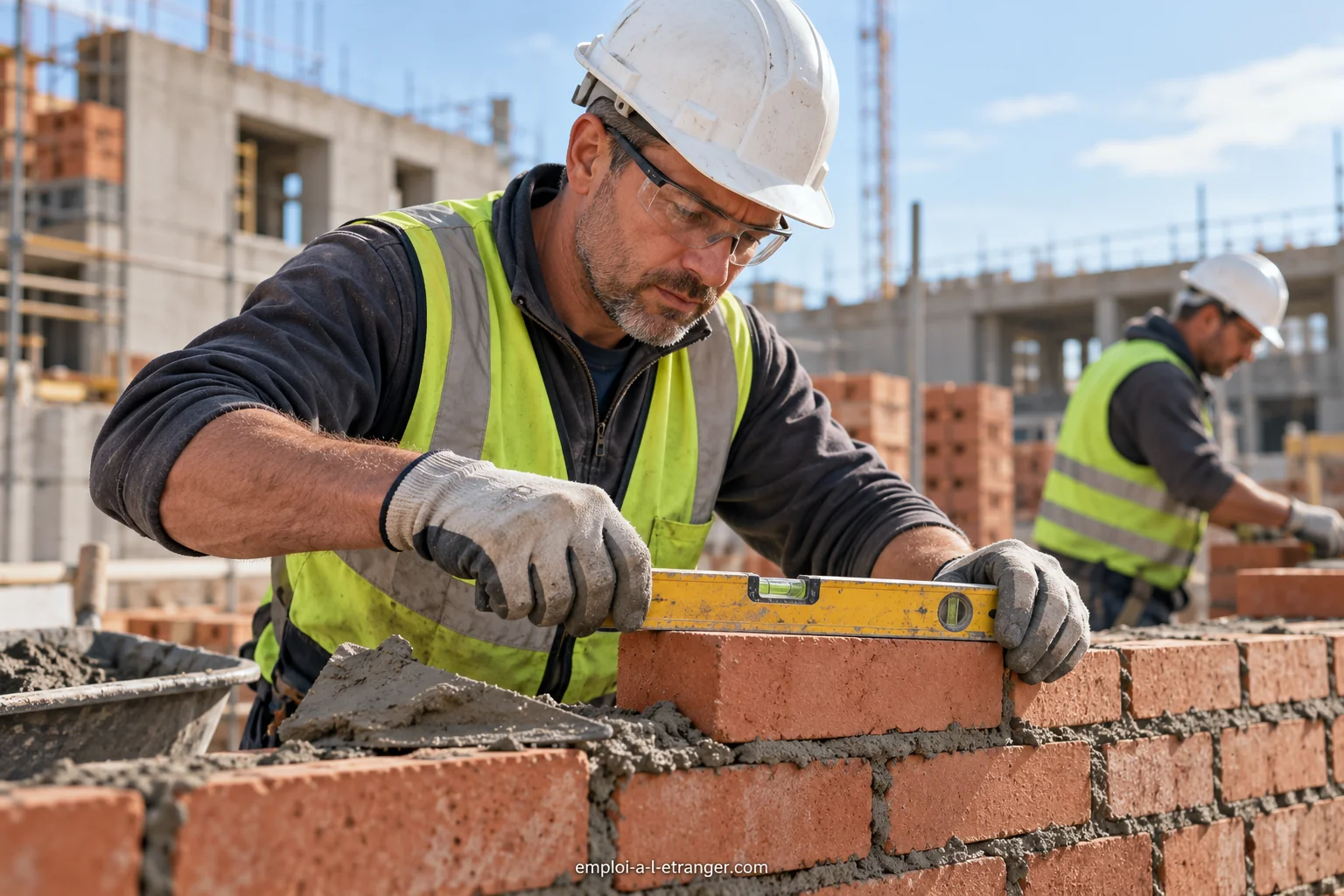
Describing your work like a bricklayer who knows what they built
A foreign employer cannot inspect your work from an office. They will read your experience as an inventory of structures: foundations, walls in brick, block or stone, slabs, rendering, renovation of old buildings, simple civil works. For each, state the material, the scale of the site and your place in the team.
Say whether you work from drawings, set out the building, read dimensions and supervise labourers. A sentence such as “building load-bearing walls on a multi-storey block, setting out from plans” tells the reader far more than a general mention of structural work.
Site references and usable photographs
The most useful references are statements from former foremen or site managers, with their contact details and the type of structure. Ask them to mention the duration, the quality of execution and your degree of independence. A foreign recruiter will rarely phone, but will appreciate knowing they could.
Photographs help if they are taken with the permission of the company or the client. Show telling details: a straight wall, even joints, a well-held corner, a neatly formed opening. Avoid pictures of workers without protective gear, which give a poor impression of your safety habits.
- Signed references from former employers
- Permitted photos of finished work
- List of materials and techniques you master
- Drawings or sketches you can read and set out
- Valid safety training and certifications
New build, renovation, structure or finishing: the advert does not say everything
The word bricklayer covers several realities. In new construction the pace is high and the work is often done in a team, with cranes and regular suppliers. In renovation you have to adapt to what exists, dealing with uneven walls and old materials. Finishing work calls for a different, finer eye.
Ask frankly: what kind of structure will you be assigned to most of the time? An infrastructure project, a block of flats and a private villa each require different skills. The employer should be able to answer precisely, without vague phrases, and ideally describe the site where you will start.
Who is your employer when several companies are involved
On large projects a main contractor calls on subcontractors, who in turn rely on agency labour. As a result, the company on your badge is not always the one that pays you. Have the contract state the name of the legal employer, its address and the person who approves your hours.
Also find out who gives the daily instructions and whom to tell about a problem: late payment, faulty equipment, an unsafe order. Groups such as VINCI, Skanska or STRABAG publish vacancies on their careers pages, but much recruitment goes through subcontractors whose existence and reputation need to be checked.
Safety, tools and protection: what to demand in writing
Construction remains one of the sectors with the most serious accidents. Before you leave, ask who supplies helmets, safety boots, gloves, harnesses and goggles, and who inspects the scaffolding. Safety instructions you can understand, in a language you speak, are among the minimum conditions of a serious job.
Ask about tools too: trowels, levels, mixers, cutting machines. Some bricklayers bring their own tools, others receive them from the company. Specify who is responsible for loss or breakage. An induction at the start of the project, with a tour of the risk areas, is a good sign of a serious firm.
Accommodation, travel and length of the project
Many overseas projects are temporary. Ask the planned duration, the possibility of an extension and what happens if the project ends earlier than expected. Depending on the contract, you may be reassigned, laid off or sent home, at your expense or at the company’s.
If housing is offered, ask for a virtual tour or photographs, and find out who pays for electricity, water and the daily transport to the site. A very long morning commute is as tiring as a day’s work. Have the return conditions written down, especially if you have to advance any costs.
Climate, pace and physical conditions on a distant site
Laying bricks in strong heat, in a humid climate or in severe cold are not the same job. Ask what breaks are planned, how drinking water is supplied and whether hours change with the seasons. Some sites start very early to avoid the hottest hours, others stop during extreme weather.
Ask about the pace expected and how it is measured: square metres built, weekly progress, target bonuses. A bonus that pushes people to work too fast raises the risk of accidents and defects. A serious employer will explain how it protects the health of its crews over the long term.
Residence papers and contract: checks before you leave
In construction, labour inspections are frequent. You therefore need the right to work in the country in the form required: a visa, an employer-linked permit or the regime that applies to your nationality. Ask the competent administration, and insist that the employer declares your job according to the rules.
Refuse any undeclared arrangement, even if it is presented as temporary. It would leave you without protection in an accident and expose you to penalties. Read the contract in a language you understand, have difficult passages translated and keep a copy of the signed documents before you leave.
Frequently asked questions
Do I need a qualification to work as a bricklayer abroad?
It varies. Some employers are satisfied with proven experience, others ask for a diploma, a certification or a local trade card. For regulated work, such as certain load-bearing structures, the requirement can be stricter. Ask the employer and the building authority of the target country.
How can I prove my bricklayer experience without a detailed CV?
Gather references from former employers, permitted photographs of your work, your payslips and your training certificates. Add a short written description of each site with the material, the duration and your role. The employer may also offer a practical trial.
What should I check in a bricklayer’s contract before leaving?
Check the employer’s identity, the place of work, the duration, the hours, the pay, overtime, accommodation, transport and return conditions. Also check the protective equipment provided and the cover in case of accident. Have any passage you do not understand translated.
Where can I find reliable building site jobs outside my home country?
Look at the careers pages of large construction groups, such as VINCI Jobs, Skanska Careers or STRABAG Karriere, and at the public employment services of the target country. Be wary of adverts promising a very high wage with no detail about the site, or asking you to pay before signing.