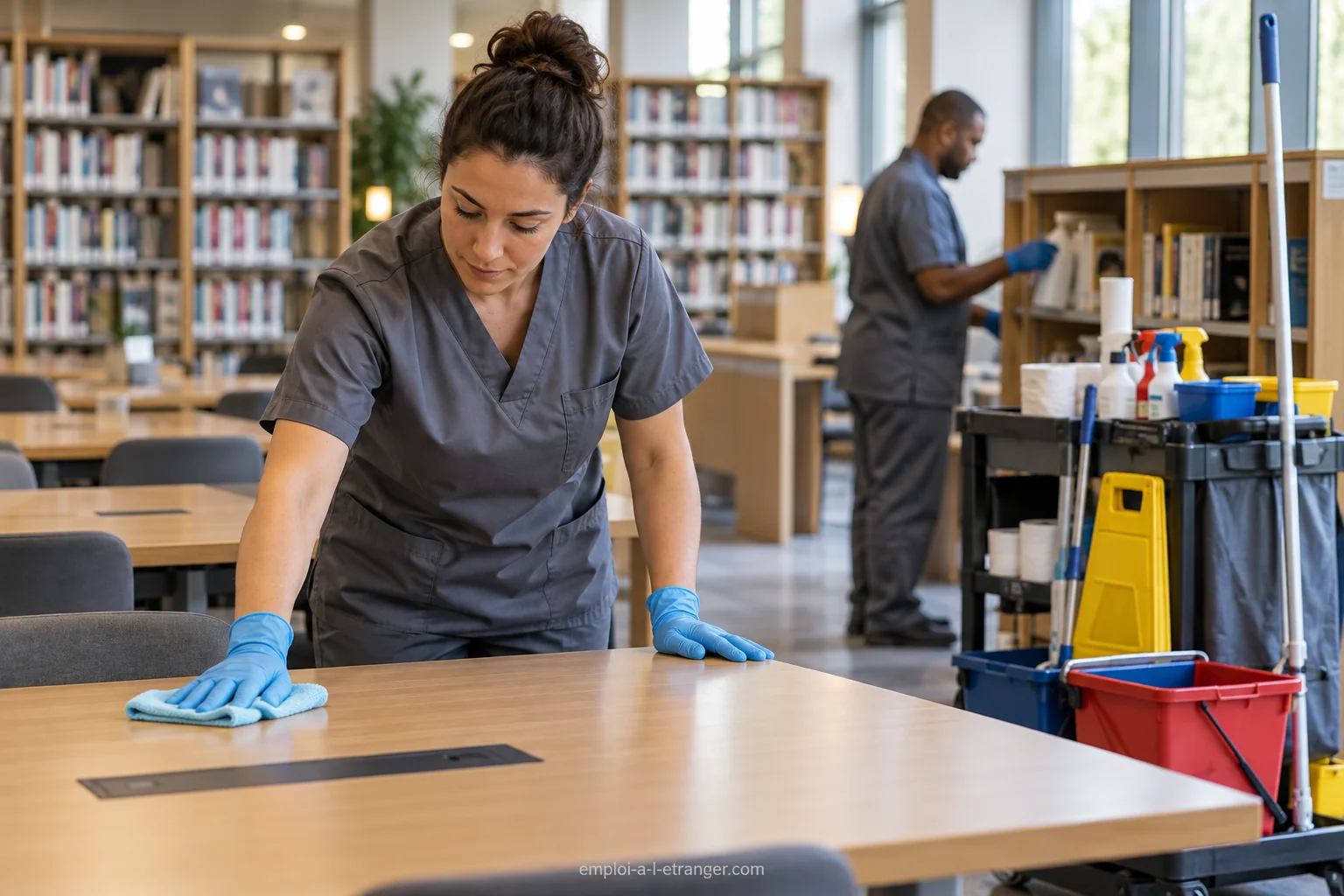
Cleaning jobs abroad cover professional cleaning in offices, hotels, hospitals and workshops, which is not a single job. Here is how to present your experience and examine an offer abroad before you sign anything. Cleaning an open-plan office in the evening, turning round a hotel room, maintaining a hospital corridor or an industrial workshop calls for neither the same movements nor the same protocols. Foreign employers first look for a profile suited to their type of site, and a candidate who can name the environment they know gains credibility.
One trade, several very different workplaces
Before applying, write the target setting in one sentence: offices, hospitality, healthcare, retail, transport or industry. Then compare it with your background. If you have only done routine cleaning, do not present yourself as ready to work in a sterile area; offer to train instead if the employer provides it.
Describe your tasks precisely on your CV
A cleaner’s CV convinces through precision. Give the floor area or type of premises, how often you visited, and the equipment you handled: scrubber-dryer, floor polisher, housekeeping trolley, steam cleaner. Mention the products you used and your compliance with dosage and storage instructions.
Add what sets a good professional apart: working independently to a schedule, reporting faults, keeping confidentiality in occupied offices, discretion around hotel guests. A reference from a former employer, even a short one, confirming dates and duties, is worth more than a long paragraph with no proof. Keep a record of the dates and conditions of each assignment, because it will help you prove your experience at the next employer.
- Type of premises and frequency of visits
- Machines and equipment you can use
- Products handled and safety instructions
- Independence, punctuality, discretion
Unsocial hours: what to have put in writing
Office cleaning often takes place early in the morning or late in the evening, hotel work during the day with peaks at room turnover, and public venues while they are closed. Ask for the typical schedule, rest days, the treatment of night and weekend hours and how cover for absent colleagues is arranged.
The rules differ from one country to another: maximum working time, breaks, any premium rates. Do not rely on the customs of your home country. Make sure the hours and the place appear in the contract, and check that they agree with the information published by the labour authority of the country concerned.
Several sites, commuting and travel time
Some contracts involve moving from one site to another on the same day. The issue is not only the distance, but also the means of transport, evening timetables and the moment when working time starts: on arrival at the first site or when you leave home.
Ask how travel between sites is handled, who bears the cost and whether time spent on the road is paid. If you do not drive, find out about public transport at the hours concerned. A job that looks attractive on paper soon becomes tiring if the night journey depends on a single bus line.
Protective equipment, products and safety training
Gloves, non-slip shoes, goggles, a mask, work clothing: the employer should in principle supply or pay for the protection a task requires, but the exact rules vary. Ask what is issued, replaced and maintained, and who pays in case of wear or loss.
Ask about training on arrival too: reading safety data sheets, mixtures that must never be made, handling a disinfectant, lifting loads, using machines safely. A serious employer trains you before leaving you alone on a site. Refuse to handle products whose name or danger you do not know.
Everyday language: labels, warnings and your supervisor
A cleaner does not need a high level of language to succeed, but must understand written instructions, product labels, danger signs and the supervisor’s directions. Misreading a bottle can have serious consequences for your health.
Assess your level honestly and ask whether instructions are available in several languages. Learn the useful vocabulary first: names of products, areas, machines and incidents. Being able to report a leak, a breakage or someone feeling unwell to a colleague in the language of the site is a real professional skill.
Cleaning company or direct employer: two different logics
You can be hired by a specialist company that assigns you to its clients, or directly by a hotel, a hospital or a school. In the first case your sites may change, under the supervision of a team leader. In the second you stay in one stable place but depend on a smaller organisation.
Large groups present in several countries, such as ISS, Sodexo or Compass Group, post their jobs on their careers sites. Read the local conditions of each offer, because the same group applies different contracts depending on the country. Ask who the legal employer is and where its head office is.
Avoiding dubious offers in low-entry-barrier services
Because this trade often recruits without requiring a degree, it attracts fake ads: housing promised without an address, an unrealistic salary, a request for application fees, a recruiter who refuses to give a written contract. Any of these signs should be enough to make you stop.
Check that the company exists, ask for the contract before you leave and confirm the work authorisation procedure with the country’s authorities. Never hand your original passport to an intermediary. If in doubt, talk to an embassy or a public employment service before paying anything.
Frequently asked questions
Do I need a degree to work as a cleaner abroad?
Rarely for routine cleaning, but some assignments in healthcare, food processing or regulated sites require training or an authorisation. Read the ad carefully and ask the employer what is required before hiring and what is taught after you arrive.
How do I prove my cleaning experience to a foreign recruiter?
Collect certificates from your former employers showing dates, sites and tasks, and your payslips if possible. Have the main documents translated. Add the name of a manager who can vouch for your reliability, after warning them about your application.
Is housing provided with this type of job?
Sometimes, but never automatically. Ask in writing whether accommodation is offered, where it is, what it may cost, how long it is available and what happens when the contract ends. Housing described orally with no trace in the contract should be treated as a mere intention.
What health risks should I know about in this trade?
The main ones are chemical products, repetitive postures, carrying loads and slips. The employer must inform and train you. Ask for the safety data sheets, use the protective equipment issued and report any irritation or lasting pain to your supervisor and to the country’s occupational health service.